Furuta Oribe (1544–1615) emerged after the aesthetic compression completed under Sen no Rikyū. He did not reject wabi. He reorganized it. His contribution was not expressive rebellion but structural expansion within an already disciplined system.
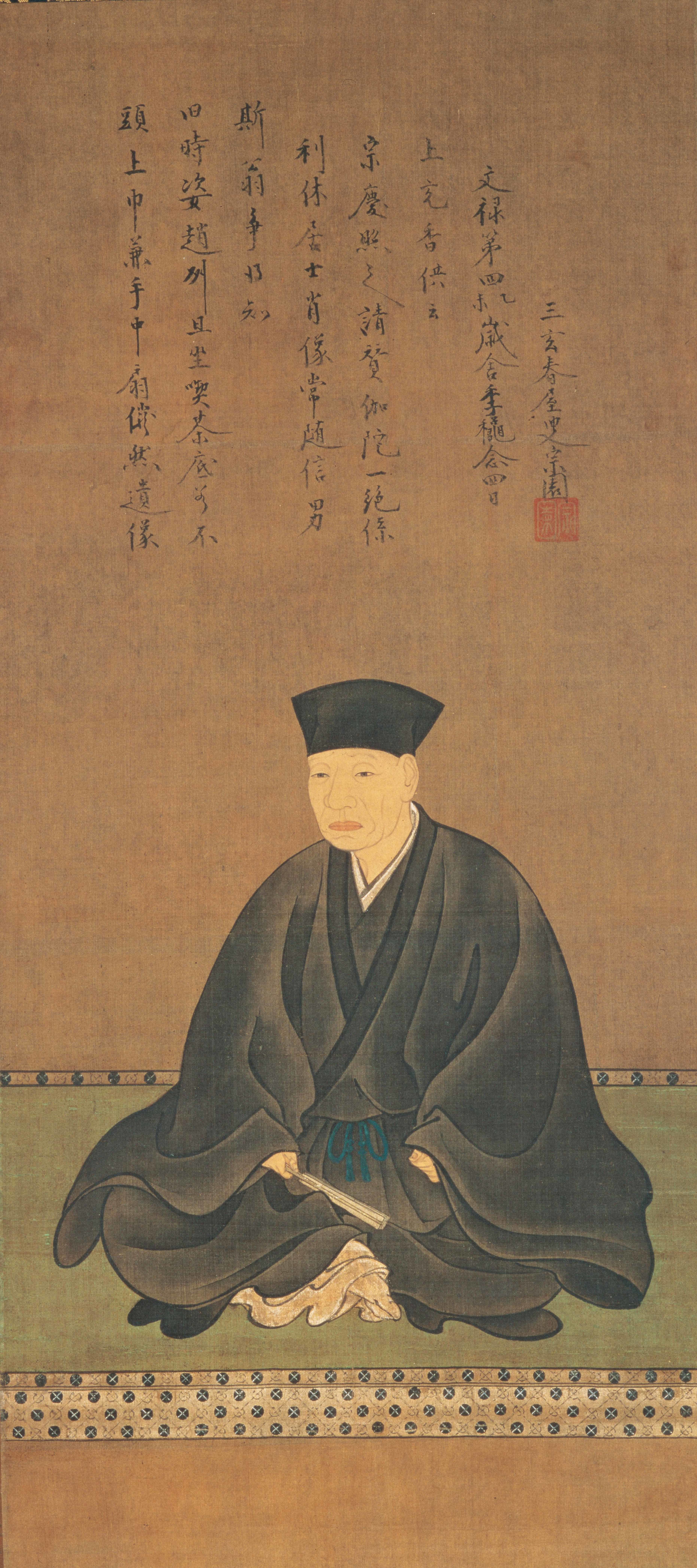
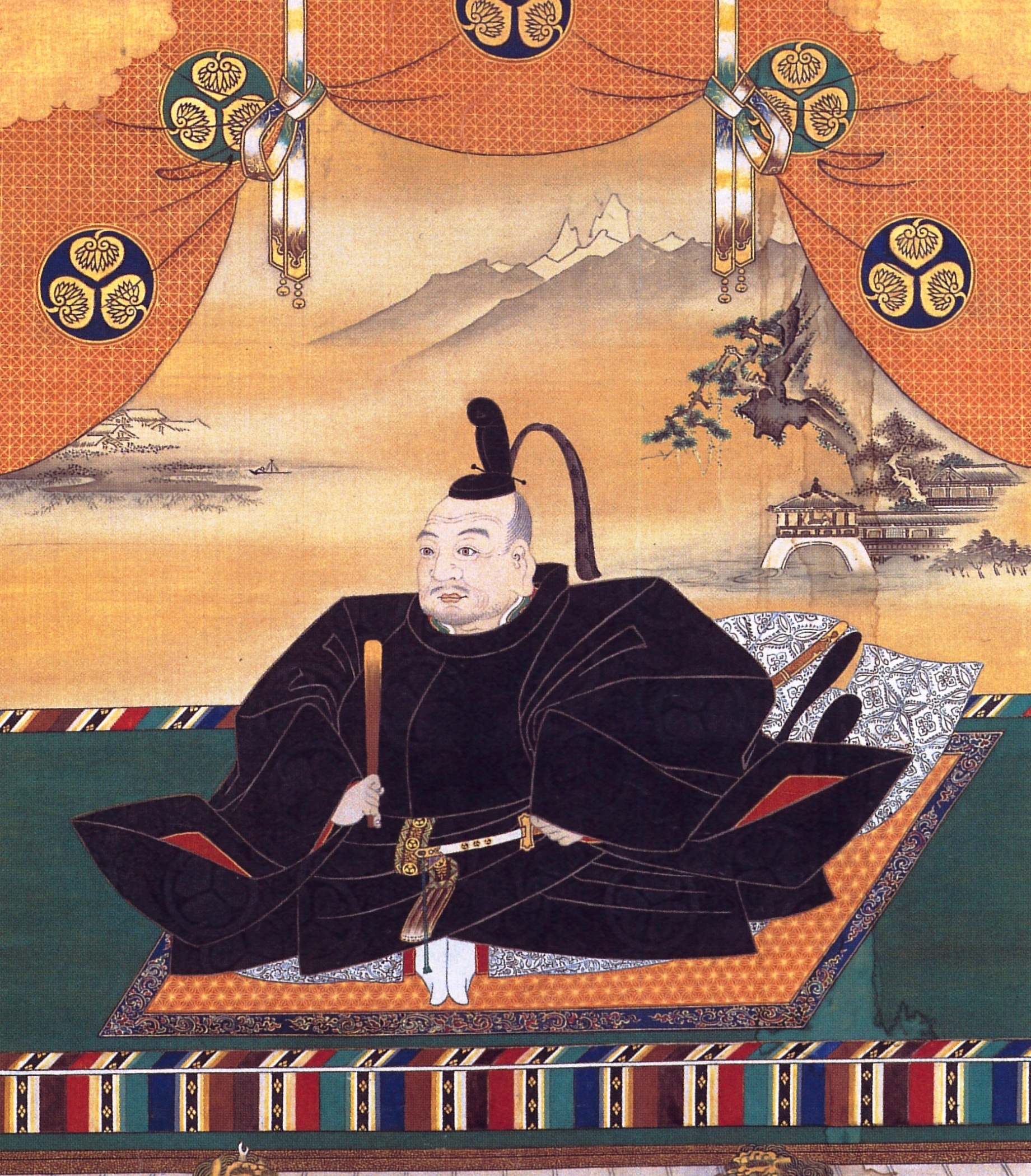
Furuta Oribe, from Chanoyu Rokushū Denki, attributed to Endō Genkai (Edo period).
Source: Wikimedia Commons.
License: Public Domain (Japan / United States).
This essay situates Oribe within the broader framework established in The Formation of Japanese Tea Practice. The issue is not stylistic novelty. The issue is how a system that had reached extreme reduction generated internal pressure and required controlled rearrangement.
1. Compression Completed Under Rikyū
Sen no Rikyū reduced chanoyu to structural clarity. Space was minimized. Implements were simplified. Surface ornament was disciplined. By the late sixteenth century, tea practice had reached a state of formal compression.
However, compression limits variation. When aesthetic vocabulary becomes extremely narrow, the system stabilizes but risks rigidity. Expansion, if it occurs, must operate within inherited grammar rather than against it.
2. Distortion as Structural Release
Oribe’s intervention should be read as controlled distortion. Distortion here does not mean collapse of order. It refers to calibrated imbalance within existing rules. The system was not broken. It was redistributed.
This redistribution appears most clearly in ceramic form. Surface hierarchy, glaze distribution, and compositional balance shift away from centered symmetry. The equilibrium becomes dynamic rather than static.
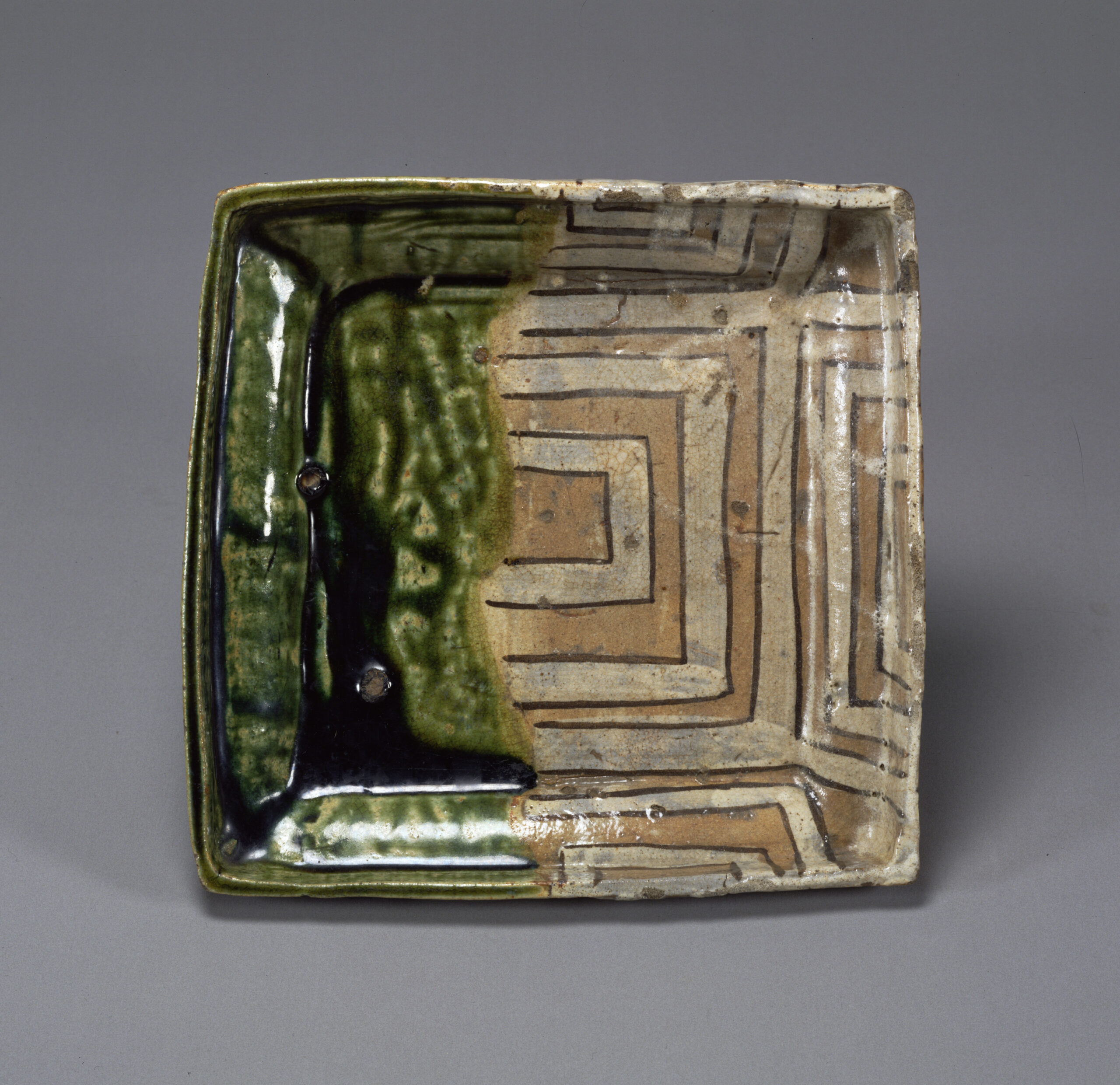
3. Surface Segmentation — Oribe Square Bowl
Oribe Square Bowl (織部角鉢), 17th century.
Holding institution: Tokyo National Museum.
Institutional ID: G-4827.
Source: ColBase (National Institutes for Cultural Heritage).
Source page: https://colbase.nich.go.jp/collection_items/tnm/G-4827
The square bowl demonstrates structural segmentation. Its interior is divided into geometric compartments. Green glaze occupies one quadrant heavily, while the remaining surfaces remain exposed or minimally treated. This distribution interrupts visual continuity.
The segmentation does not create chaos. Instead, it redistributes attention. The eye moves between planes rather than resting at a centered focal point. Surface hierarchy becomes multi-nodal.
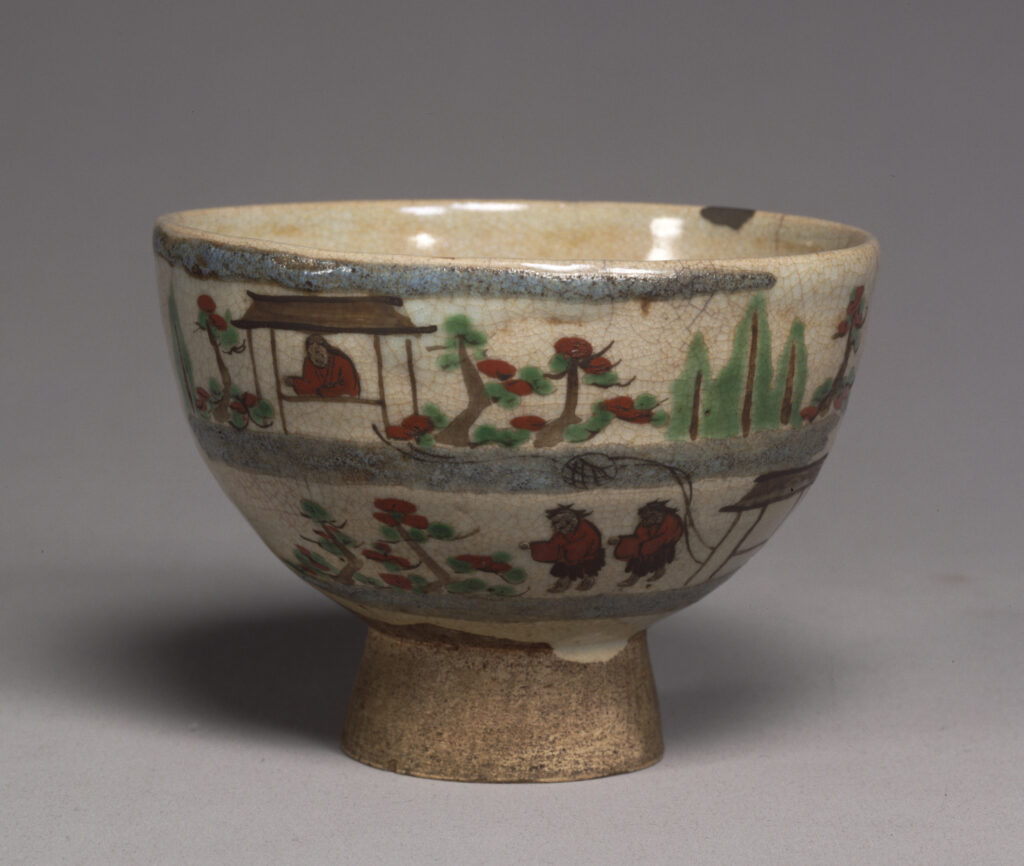
4. Glaze Displacement — Green-Glazed Flat Bowl
Green-Glazed Flat Bowl with Peach Motif (緑釉銹絵桃文平鉢), Momoyama period (17th century).
Holding institution: Kyoto National Museum.
Institutional ID: G甲300.
Source: ColBase (National Institutes for Cultural Heritage).
Source page: https://colbase.nich.go.jp/collection_items/knm/G%E7%94%B2300
This flat bowl presents asymmetrical glaze displacement. The copper green glaze concentrates on one side, while the opposite surface remains comparatively open. The decorative motif does not align with geometric center.
Such displacement produces lateral tension. The composition is stable yet visibly unbalanced. The system allows imbalance as long as proportional relations remain controlled.
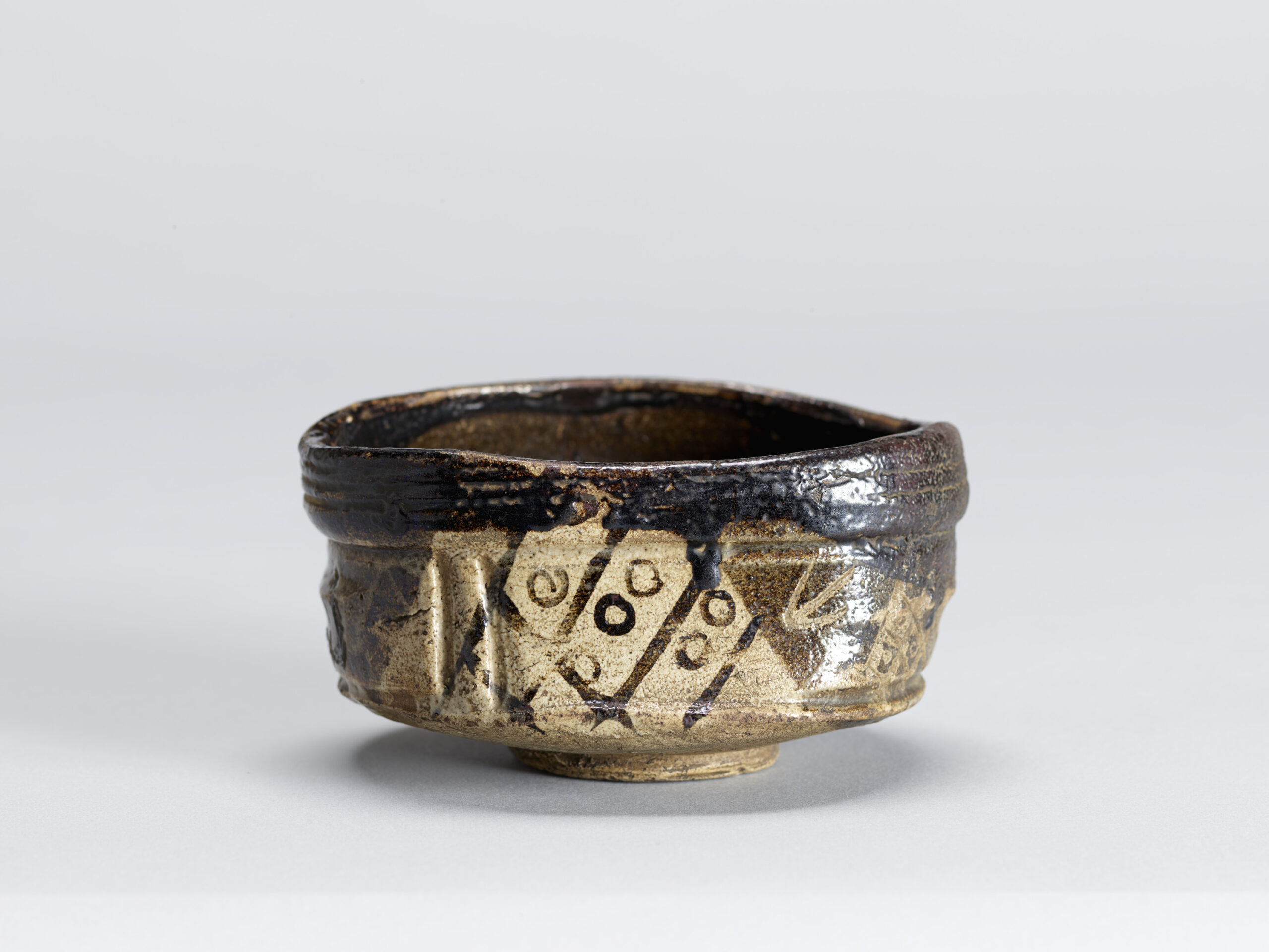
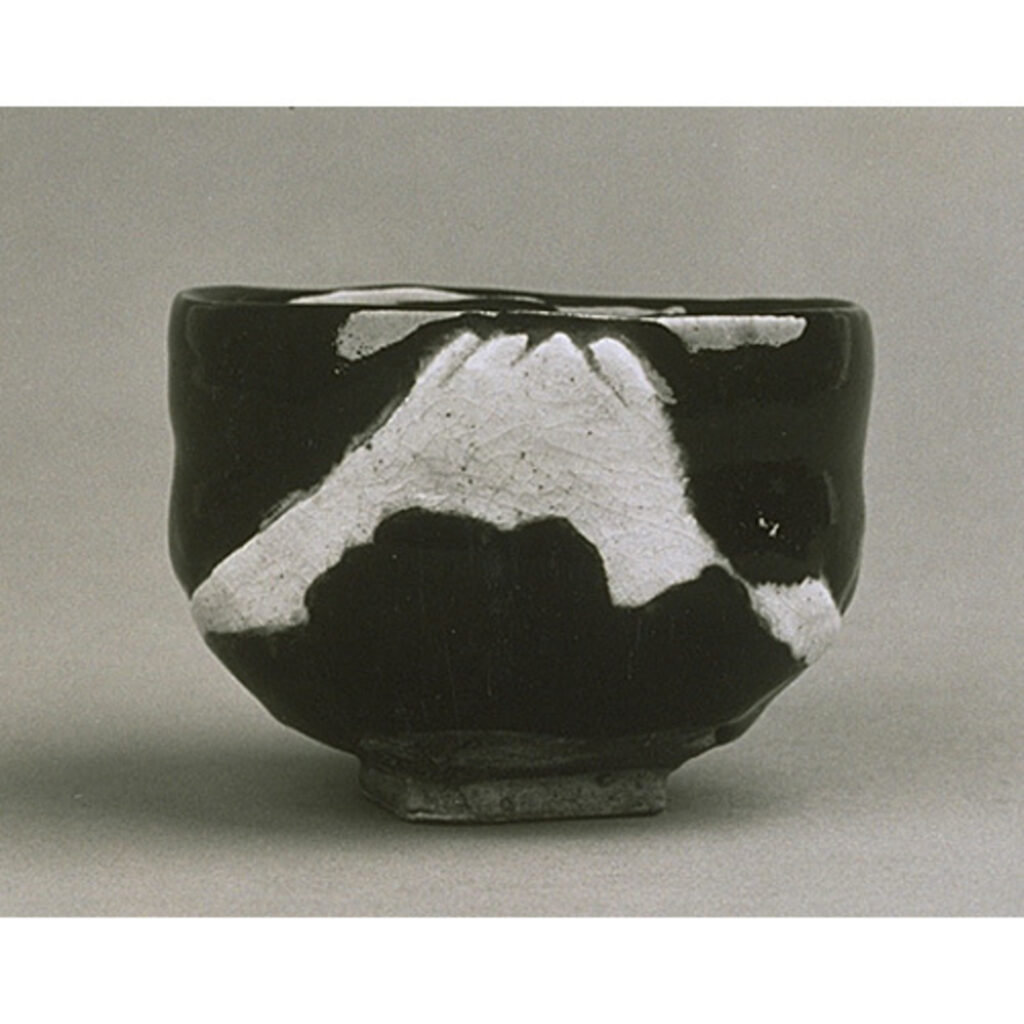
5. Redistribution of Compression — Black Oribe Tea Bowl
Black Oribe Tea Bowl (黒織部茶碗), 17th century.
Holding institution: Kyoto National Museum.
Institutional ID: G甲638.
Source: ColBase (National Institutes for Cultural Heritage).
Source page: https://colbase.nich.go.jp/collection_items/knm/G%E7%94%B2638
The black Oribe tea bowl demonstrates redistribution within a compressed form. The cylindrical body retains structural compactness. However, a horizontal band of decoration interrupts the visual field.
Compression remains intact, yet visual rhythm increases. The object reorganizes restraint into layered hierarchy.
6. Political Context and Stabilization
Oribe’s structural expansion occurred during the transition from Momoyama turbulence to early Tokugawa order. Tea was no longer confined to monastic or merchant circles. It became embedded within samurai administration.
This shift required aesthetic adaptability. Extreme minimalism alone could not sustain broader institutional use. Controlled distortion allowed variation without dissolving inherited discipline. The system expanded while preserving internal grammar.
In this sense, Oribe functioned as a mediator. He neither abandoned compression nor intensified it. He redistributed it so that chanoyu could operate within emerging political stability.
Conclusion
Furuta Oribe did not dismantle the aesthetic achieved under Sen no Rikyū. He redistributed its internal weight. Distortion in his work operates as structural release within inherited constraints. This controlled expansion enabled the transition from extreme compression toward adaptive stabilization.
References
Kumakura, I. (2001). Furuta Oribe to Momoyama no Cha. Tankōsha.
Yabe, Y. (1999). Furuta Oribe: Momoyama Bunka o Enshutsu Suru. Kadokawa.
Fujio, M. (1978). Momoyama no Cha to Furuta Oribe. Chūō Kōron.
Hayashiya, T. (1970). Chanoyu. Kodansha International.
ColBase (National Institutes for Cultural Heritage). Object records: G-4827, G甲300, G甲638.
What Is Meibutsu? The Value System of Named Tea Objects in Japan
In Japanese tea culture, meibutsu does not simply mean a famous object. It refers to a structured system in which certain tea objects were named, ranked, authenticated, and transmitted within elite networks. Once an object received a name, it entered a hierarchy of recognition that connected aesthetic evaluation with political authority.
This article examines the historical formation of the meibutsu system, from Muromachi-period ranking practices to Momoyama transformation and Edo institutional stabilization.
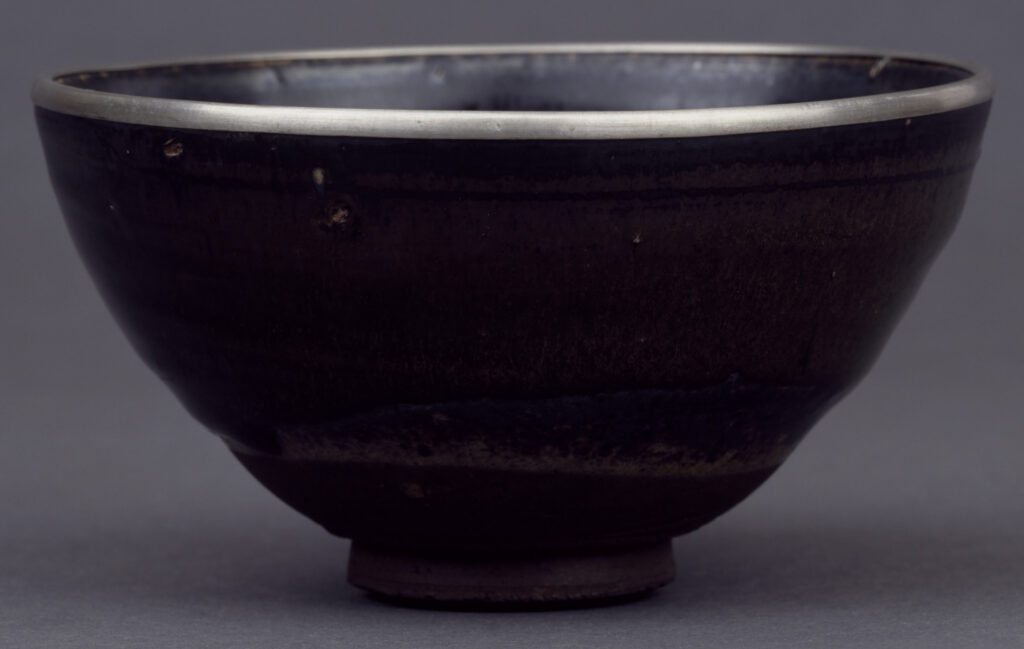
Yuteki Tenmoku (oil-spot tea bowl), Southern Song dynasty (12–13th century).
Collection: The Museum of Oriental Ceramics, Osaka.
Source: Wikimedia Commons.
License: CC BY 4.0.
File: Yuteki_Tenmoku_(The_Museum_of_Oriental_Ceramics,Osaka)_11.jpg
1. Muromachi Origins: Karamono and Ranking Authority
The origins of the meibutsu system lie in the Muromachi period’s culture of karamono (Chinese imports). Tea caddies, Tenmoku bowls, and incense vessels from the continent were classified and ranked within the Ashikaga shogunate’s collection. Documentation and provenance became inseparable from aesthetic judgment.
This early ranking practice created a dual structure: aesthetic distinction and institutional validation. Objects were not merely admired; they were catalogued and positioned within formal hierarchies.
Haikatsugi Tenmoku (ash-covered Tenmoku tea bowl), Song dynasty (13–14th century).
Collection: Kyoto National Museum.
Source: ColBase (National Institutes for Cultural Heritage).
Collection ID: G甲542.
License: Free for secondary use with attribution.
2. Naming and Authority: From Object to Recognized Status
The act of naming transformed an object’s status. A tea object with a recorded lineage and a recognized name gained institutional legitimacy. The authority to name or authenticate such objects became concentrated among elite tea practitioners and political leaders.
Meibutsu therefore functioned as a controlled recognition system. It regulated which objects counted as exemplary and which did not. Naming created inclusion; silence produced exclusion.
3. Rikyu and Value Reorientation
Portrait of Sen no Rikyu, attributed to Hasegawa Tōhaku (late 16th–early 17th century).
Ink and color on silk, hanging scroll.
Source: Wikimedia Commons.
License: Public Domain.
File: Sen_no_Rikyu_JPN.jpg
Sen no Rikyu did not abolish the meibutsu system; he reoriented its evaluative criteria. While earlier ranking emphasized continental prestige, Rikyu shifted attention toward material presence, proportion, and situational harmony. The authority to recognize value remained structured, but its aesthetic focus moved.
This shift did not dissolve hierarchy. It recalibrated it. Recognition continued to depend on certification and recorded transmission.
4. Political Expansion Under Hideyoshi
Hatsuhana Katatsuki (tea caddy), Momoyama period.
Collection: Tokugawa Memorial Foundation (as noted on Commons).
Source: Wikimedia Commons.
License: Public Domain (PD-Japan).
File: Hatsuhana_Katatsuki,_front_view_(color).jpg
Under Toyotomi Hideyoshi, named objects became integrated into broader political consolidation. The system of recognition intersected directly with sovereign power. Ownership, display, and redistribution acquired explicit political meaning.
It is important to distinguish this political deployment from the structural definition of meibutsu itself. The system existed before large-scale consolidation; it was later intensified and strategically mobilized.
5. Edo Institutional Stabilization
In the Edo period, the meibutsu system stabilized through formal documentation, lineage recording, box inscriptions, and catalog production. Classification categories such as ō-meibutsu and chū-meibutsu standardized evaluation.
Custody replaced spectacle. Certification replaced accumulation. The system endured not through dramatic transfer but through administrative continuity.
6. Structural Characteristics of the Meibutsu System
The meibutsu system can be described through five structural elements:
Naming authority concentrated within recognized lineages.
Documented provenance linking object and status.
Hierarchical ranking embedded in institutional memory.
Political alignment expressed through controlled display.
Selective invisibility of objects outside recognition networks.
Meibutsu was therefore not simply a matter of fame or beauty. It was a governance structure of value within Japanese tea culture. Through naming, ranking, and documentation, aesthetic distinction became socially regulated and historically durable.
References
Kumakura, Isao. History of Chanoyu.
Pitelka, Morgan. Japanese Tea Culture.
Sen, Sōshitsu. The Japanese Way of Tea.
Primary tea diaries and catalogues of named objects.
Meibutsu Hunting: The Reconfiguration of Tea Value Under Sovereign Power
“Meibutsu hunting” refers to the consolidation and controlled redistribution of named tea objects during the late Sengoku and early Edo periods. It was not a marginal practice of luxury. It was a structural mechanism through which authority, rank, and legitimacy were made visible. As political power centralized, prized tea objects moved toward sovereign control, and their ownership acquired formal political meaning.
This essay examines meibutsu hunting as a system of value reconfiguration. It focuses on object capture, managed display, authentication authority, and eventual institutional stabilization. The emphasis is not narrative drama, but structural transformation.
Hatsuhana Katatsuki (tea caddy), Momoyama period.
Reproduced from Taishō Meikikan (1937).
Collection: Tokugawa Memorial Foundation (as noted on Commons).
Source: Wikimedia Commons.
License: Public Domain (PD-Japan).
File: Hatsuhana_Katatsuki,_front_view_(color).jpg
1. Object Capture and Centralization
During territorial consolidation, named tea objects were gathered through forced transfer, compelled offering, asymmetric purchase, and post-conflict redistribution. These movements paralleled political restructuring. Land and offices were reassigned; so were cultural assets. Because meibutsu were portable, identifiable, and recordable, they functioned as compact units of elite reward.
Centralization required visibility. A named object displayed in a regulated gathering became proof of proximity to power. The sovereign side controlled both the object and the setting that made the object socially legible. Ownership thus became inseparable from political alignment.
Under Hideyoshi, accumulation intensified and public display expanded. Large gatherings amplified recognition and increased the stakes of naming. The broader the audience, the more critical certification became. Control over which objects counted as meibutsu — and who had authority to define them — narrowed into fewer hands.
Redistribution did not dilute control. When a named object was assigned to a retainer, it functioned as a credential within a supervised hierarchy. The object signaled alignment within sovereign structure, while remaining embedded in a centralized recognition system.
3. Displacement and Memory
Mid-level holders of named objects experienced displacement as authority compressed toward fewer centers. Objects moved; recorded names endured. Political rank shifted more rapidly than object memory. Tea diaries and chronicles preserved ownership chains even when political fortunes reversed.
Later narratives sometimes dramatized moments of refusal or destruction. Whether every detail is historically verifiable is secondary to the structural implication: object transfer had become politically legible. The preservation of such stories indicates the degree to which named objects functioned as markers of alignment within sovereign order.
4. Administrative Stabilization
Tokugawa Ieyasu, portrait attributed to Kanō Tan’yū (early 17th century).
Source: Wikimedia Commons.
License: Public Domain (PD-Japan).
File: Tokugawa_Ieyasu2.JPG Letter from Tokugawa Ieyasu to Mogami Yoshiaki (early 17th century).
Collection: Honma Museum of Art.
Source: Wikimedia Commons.
License: Public Domain.
File: Letter_from_Tokugawa_Ieyasu_to_Mogami_Yoshiaki_(Honma_Museum_of_Art).jpg
With the establishment of Tokugawa rule, the dynamic circulation of objects gave way to regulated custody. Authority shifted from performative accumulation to administrative stabilization. Named objects were catalogued, stored, and integrated into a governed hierarchy. Documentation became as significant as possession.
The sovereign display of value transformed into bureaucratic order. Custody, certification, and controlled access defined prestige. The system no longer relied on spectacular demonstration; it relied on durable record and institutional continuity.
5. Structural Consequences
Three consequences followed. First, value intensified through proximity to centralized authority. Second, authentication power concentrated into fewer channels. Third, selective invisibility increased as everyday objects fell outside elite recognition systems.
Meibutsu hunting was therefore not merely acquisition. It was a governance technology of value. It reorganized ownership, narrowed interpretive authority, and embedded cultural capital within sovereign structure. The mechanism did not disappear with peace; it stabilized and endured in institutional form.
References
Varley, P., & Kumakura, I. (1989). Tea in Japan: Essays on the History of Chanoyu. University of Hawai‘i Press.
Kumakura, Isao. Studies on Momoyama and early Edo tea culture.
Primary tea diaries and contemporary chronicles (critical editions).
Wikimedia Commons file pages for images cited above.
Situated within The Formation of Japanese Tea Practice, Sen no Rikyū did not invent tea, nor did he merely refine an aesthetic. He redesigned how value operated in sixteenth-century Japan. Through compressed space, recalibrated materials, regulated exchange, and proximity to sovereign authority, he constructed a system in which cultural meaning, economic coordination, and political visibility intersected.
Building upon the stabilizing work of Takeno Jōō, Rikyū intensified structural reduction and transformed chanoyu into a high-density ritual system.
Portrait of Sen no Rikyū, hanging scroll, Momoyama period (16th century), artist unknown.
Collection: Masaki Art Museum (Osaka, Japan).
Source: Wikimedia Commons (“Sen no Rikyu (Masaki Art Museum).jpg”).
License: Public Domain (PD-Art).
1. Space as Regulation
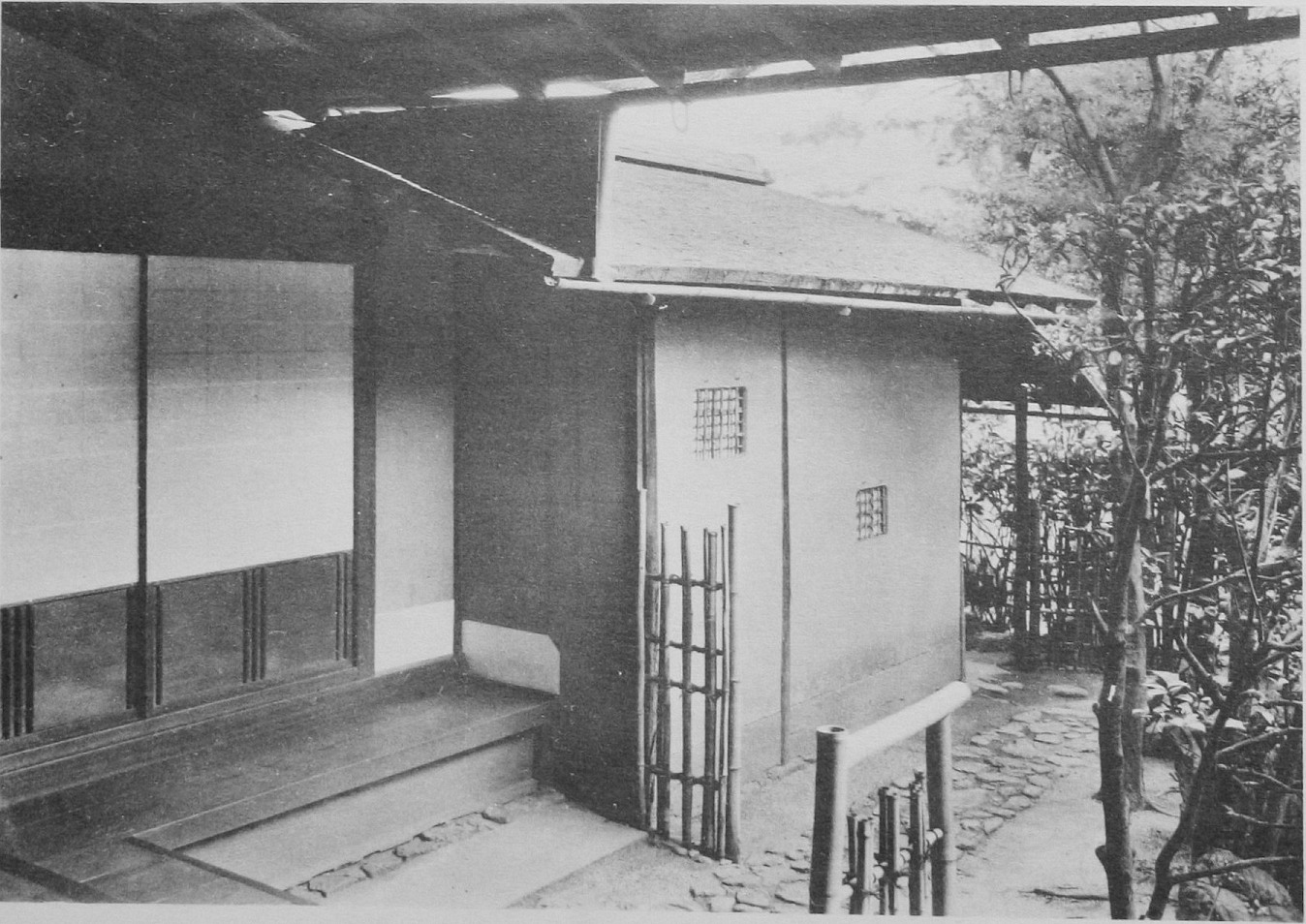
Tai-an tea house, Myōki-an, Kyoto. Late 16th century.
Source: Wikimedia Commons.
License: Public Domain.
Tai-an, the small tea room associated with Rikyū, compresses the body and restricts movement. The two-mat configuration reduces spatial hierarchy. The narrow entrance lowers posture and standardizes entry. Architecture becomes a regulatory device.
This spatial compression intensifies attention. Fewer elements enter the room, and each carries greater weight. The gathering becomes a controlled environment in which selection, pacing, and conduct are legible. Space does not decorate tea; it governs it.
2. Material Revaluation
Black Raku tea bowl, Chōjirō ware, Momoyama period (late 16th century).
Aichi Prefectural Ceramic Museum.
Source: Wikimedia Commons.
License: CC BY-SA 4.0.
Working in close association with the potter Chōjirō, Rikyū helped establish the black Raku bowl as a new ceramic form. Unlike imported Chinese wares valued as trophies of political prestige, the Raku bowl was locally produced and hand-formed. Its surface absorbs light rather than reflects it. Irregularity replaces symmetry.
This was not a rejection of value but a redirection of value. Authority moved from rarity and distance to immediacy and embodied use. The bowl centers the act of holding rather than visual admiration.
Bamboo flower vase, traditionally attributed to Sen no Rikyū (16th century).
Sekisui Museum, Mie Prefecture.
Source: Wikimedia Commons.
License: CC BY-SA 4.0.
Bamboo flower vessels traditionally linked to Rikyū extend this revaluation. Simple organic material replaces lacquer and metal. Whether every surviving example is authentic or not, the structural shift is clear: raw material acquires legitimacy within the ritual system.
3. Exchange and Monetary Coordination
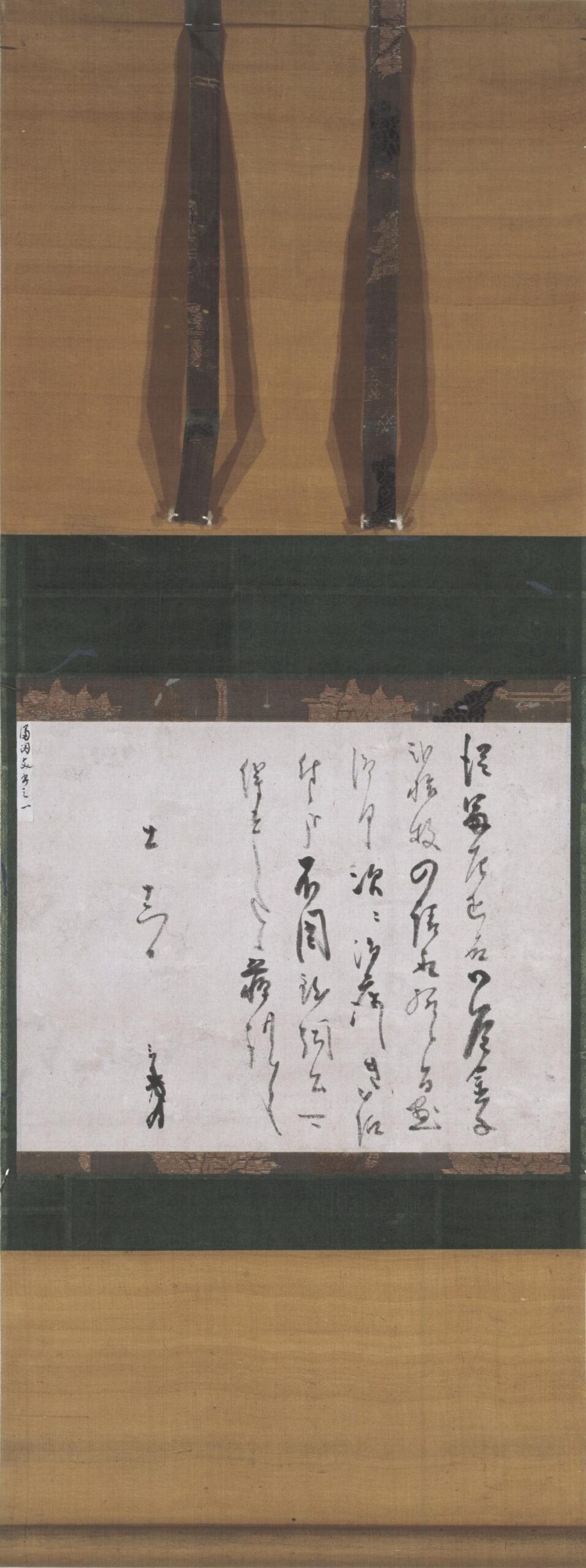
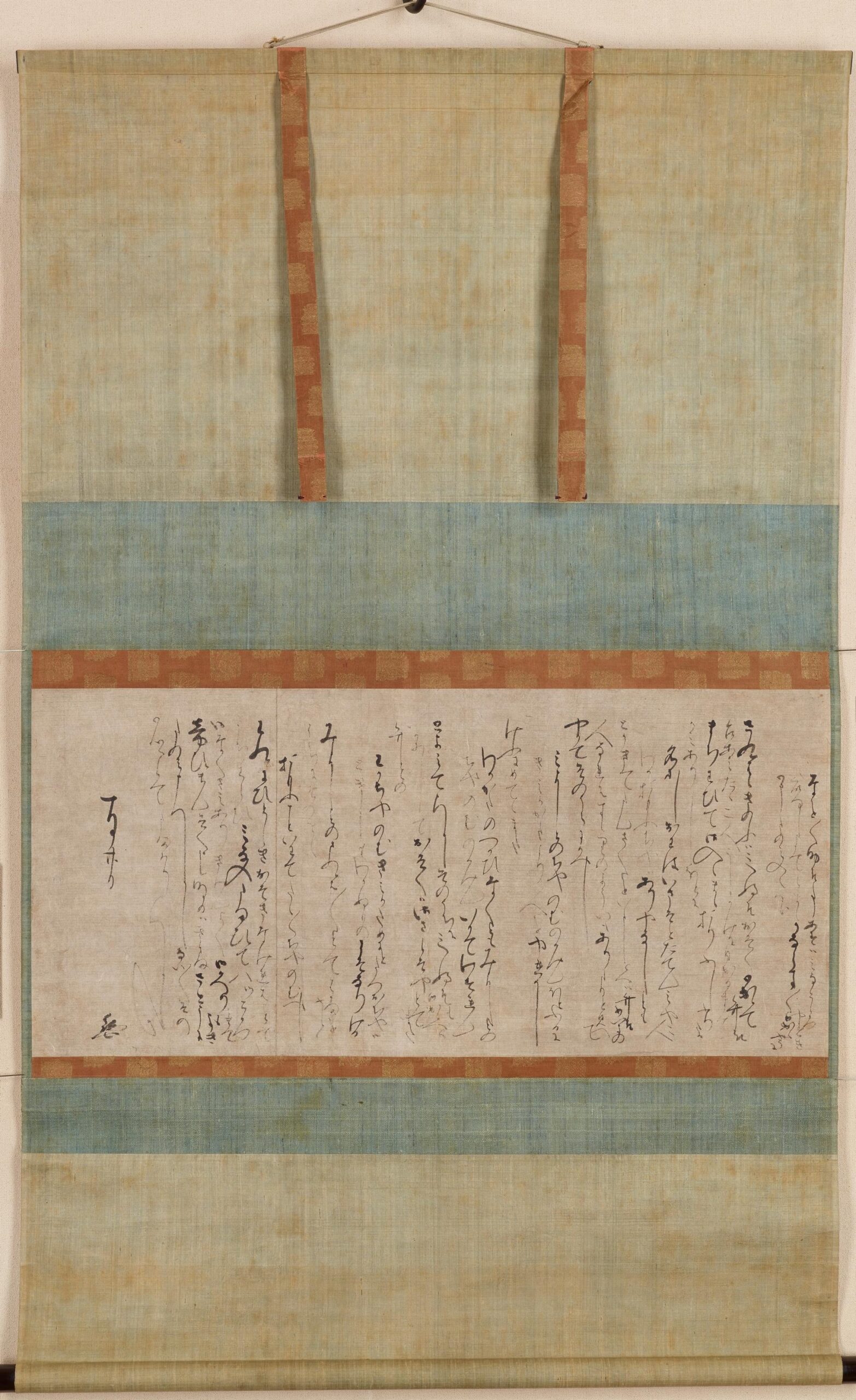
Letter referencing monetary terms and tea-related exchange, attributed to Sen no Rikyū.
Azuchi–Momoyama period, 16th century.
Collection: Tokyo National Museum.
Source: ColBase (National Institutes for Cultural Heritage, Japan).
Object ID: B-3332.
License: CC BY 4.0.
This letter records monetary terms connected to tea-related exchange. Tea practice operated within financial coordination. Objects were purchased, transferred, and accounted for. Cultural authority required logistical precision.
Rikyū did not stand outside economic circuits. He functioned within merchant and warrior networks in which value moved through documented exchange. The ritual system depended on stable coordination beyond the tearoom.
4. Sovereign Proximity and Tension
Rikyū served Oda Nobunaga and Toyotomi Hideyoshi during a period when prized tea objects were centralized and redistributed. Tea gatherings became sites of sovereign display. Cultural legitimacy and political authority converged.
Rikyū’s system intensified compression under this visibility. Spatial restriction, strict selection, and heightened relational discipline increased the informational density of each gathering. Such a system delivers clarity but reduces tolerance for deviation.
High compression produces high tension. When ritual authority and sovereign authority overlap too closely, fragility increases. The structure becomes powerful yet unstable.
Conclusion
Sen no Rikyū was not reducible to a saint, a martyr, or a stylist. He was not solely a political actor or solely a spiritual reformer. He was a designer of value.
Through regulated space, recalibrated material, documented exchange, and operation under sovereign scrutiny, he intensified tea into a high-tension system. That system reshaped how authority could be embodied, circulated, and perceived.
The forms he consolidated—architectural compression, material redirection, and controlled coordination—remain embedded in tea practice long after his death.
The extreme compression he achieved would later require redistribution. That structural expansion would be undertaken by Furuta Oribe, who reorganized tension without dissolving inherited grammar.
References
Kumakura, Isao. (1994). Sen no Rikyū. Yoshikawa Kōbunkan.
Takeno Jōō (1502–1555) is best understood as a structural stabilizer. Murata Jukō compressed tea practice into a smaller,
portable form. Jōō made that compression socially sustainable inside Sakai, an urban merchant environment organized through
exchange, credit, and repeatable interaction. He did not found an aesthetic school. He stabilized a workable format within a
networked city.
The main claim is simple. Jōō made compressed tea repeatable in a merchant world. He made it usable as a social instrument.
This was structural stabilization.
1. Takeno Jōō and Sakai Tea Culture
In the sixteenth century, Sakai functioned as an autonomous merchant city with strong maritime connections. Authority depended
less on court rank than on commercial reputation and negotiated order. In such an environment, trust required visible and
repeatable signals of reliability. Tea gatherings operated as one such signal within merchant networks.
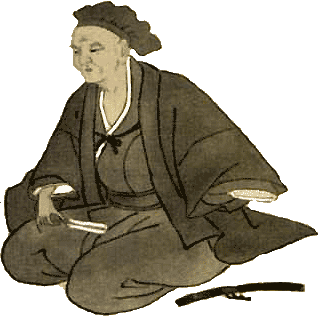
Portrait of Takeno Jōō (later copy, Edo period).
Source: Wikimedia Commons.
License: Public Domain.
File: Takeno_Jouou.jpg.
Sakai’s merchant networks depended on credit, and credit depended on predictability. Transactions were not secured only by
formal state enforcement. They were secured by reputation, reciprocal obligation, and the ongoing monitoring of behavior within
dense circles. Reliability could not remain a private claim. It had to be confirmed through repeated encounters and shared
evaluation.
Tea gatherings provided a controlled format for such confirmation. They were not simply leisure events. They were small-scale
institutions that regulated attention, pacing, and conduct. The constraints of the setting reduced the noise of everyday
commerce and made social signals more legible. Hosting skill, appropriate selection, and maintained order under constraint
functioned as a public demonstration of competence.
This helps explain why Jōō matters structurally. Compression could survive outside monastic authority only if it became legible
and repeatable across households. A reduced format must be teachable, replicable, and recognized as “proper” by people who share
no court hierarchy. Jōō’s stabilization is the mechanism that made compressed tea compatible with Sakai’s credit-based urban
system.
2. Compression Inside Merchant Culture
Tea in Sakai developed among merchants who had access to imported wares and recognized prestige objects. Reduction therefore
functioned as deliberate moderation within abundance rather than as an expression of scarcity. By narrowing comparison and
tightening selection, compression stabilized interaction inside competitive networks. What later generations labeled “early wabi
tea” can be read structurally as selected moderation within an urban economy.
A merchant environment can treat objects as both cultural signals and transferable assets. Imported items, celebrated utensils,
and named pieces could circulate through gifting, purchase, pledge, or mediated exchange. This creates a problem for gathering
design. If a tea meeting becomes a pure arena of display, it increases rivalry and undermines the stability of relationships the
network depends on. Compression offers a practical response. It limits the field of display and shifts evaluation toward
proportion and suitability.
Moderation also protects meaning. When only a small number of items enter the room, each selection becomes consequential, and
the host must justify it through coherence rather than through price or provenance alone. The setting encourages a type of
judgment that fits urban coordination: stable criteria, shared expectations, and reduced volatility. The point is not moral
austerity. The point is operational stability inside Sakai tea culture.
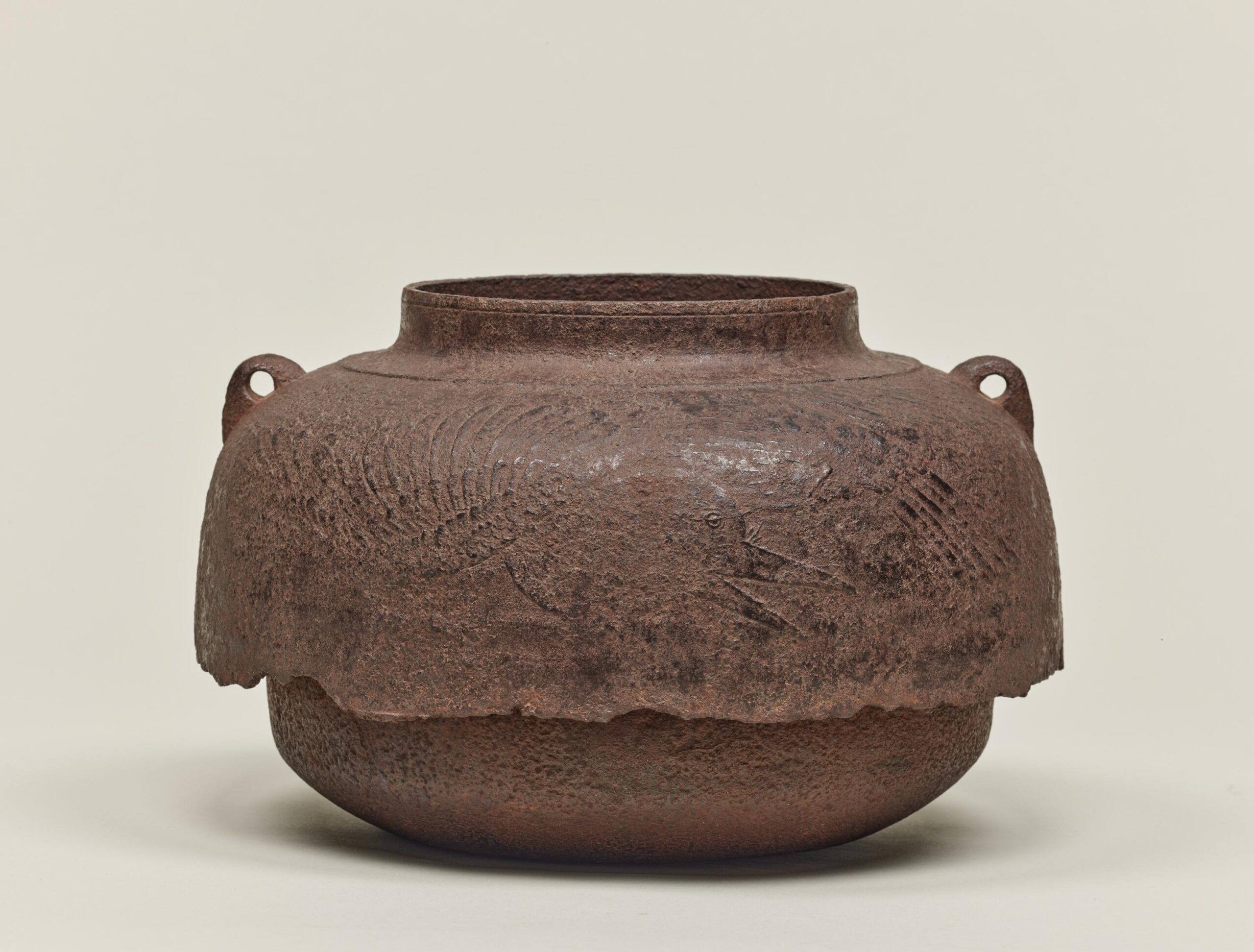
Kettle with bird design, inscribed “Nuregarasu,” Muromachi period (15th–16th century).
Collection: Tokyo National Museum.
Source: ColBase (National Institutes for Cultural Heritage, Japan).
Object ID: E-20001.
License: CC BY 4.0.
Objects associated with elite circulation could still appear within moderated gatherings, but their function changes. Rather
than dominating attention as trophies, they become components inside a calibrated system of selection. This is consistent with
Jōō’s position as a stabilizer: not rejecting prestige objects outright, but embedding them inside a reduced and regulated
format where they support coordination rather than destabilize it.
3. Formal Refinement as Stabilization
Jōō’s contribution can be described as formal refinement that made compression operational. Stabilization required repeatable
sequence, recognizable proportion, and a functional object hierarchy. Refinement here indicates calibration rather than luxury.
By reducing contested decisions and clarifying what must remain constant, Jōō helped make compressed tea reproducible within
Sakai’s networks.
A compressed gathering fails when it becomes ambiguous. If utensils appear without clear ordering, if pacing shifts without
shared expectation, or if criteria of selection change unpredictably, the room becomes a site of disagreement. In a credit-based
society, disagreement has cost. It weakens trust and increases friction across future transactions. Stabilization therefore has
a practical aim: to minimize uncertainty by standardizing what participants can reasonably expect.
This is where “form” becomes a stabilizing technology. A repeatable sequence organizes attention. Recognizable proportion limits
interpretive conflict. A functional hierarchy of objects prevents confusion about what matters at each moment. The host’s
competence becomes measurable, and the guests’ evaluation becomes more consistent. These conditions allow the practice to scale
across households without requiring a central institution to police correctness.
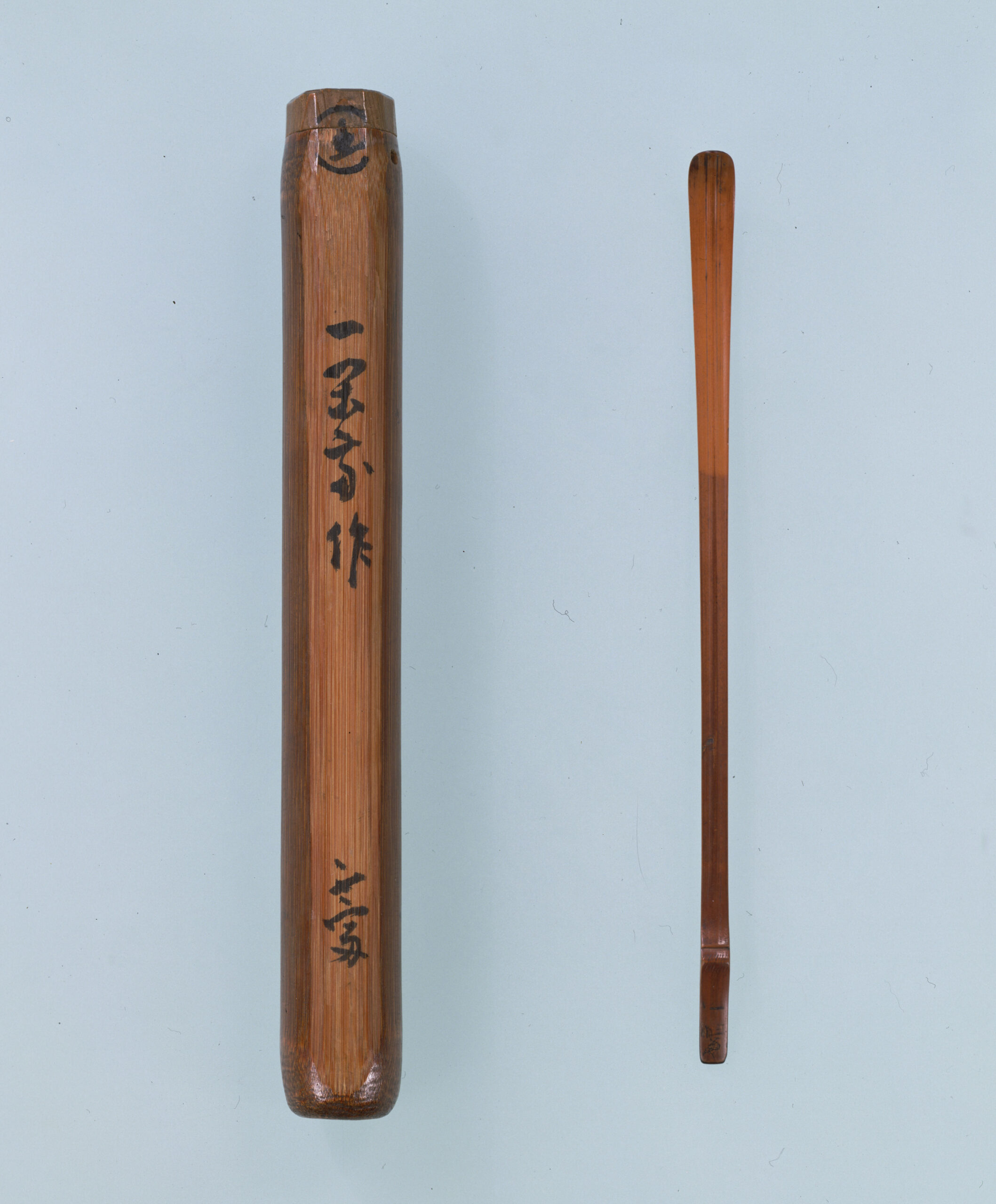
Bamboo tea scoop (chashaku) attributed to Takeno Jōō, Muromachi period (16th century).
Collection: Tokyo National Museum.
Source: ColBase (National Institutes for Cultural Heritage, Japan).
Object ID: G-5373.
License: CC BY 4.0.
A bamboo tea scoop is a useful structural symbol because it is not impressive by scale or material, yet it is decisive in
practice. It participates in proportional calibration and in repeatable handling. When such objects become standardized within
circles, they reinforce a shared grammar of action. In that sense, the stabilization of small implements supports the
stabilization of the gathering as a whole.
4. Documentary Evidence in Merchant Communication
Surviving documents attributed to Jōō provide material evidence of tea practice within merchant communication networks. Letters
demonstrate coordination, exchange, and the practical dimension of gatherings. They anchor stabilization in documented
interaction rather than retrospective aesthetic labeling.
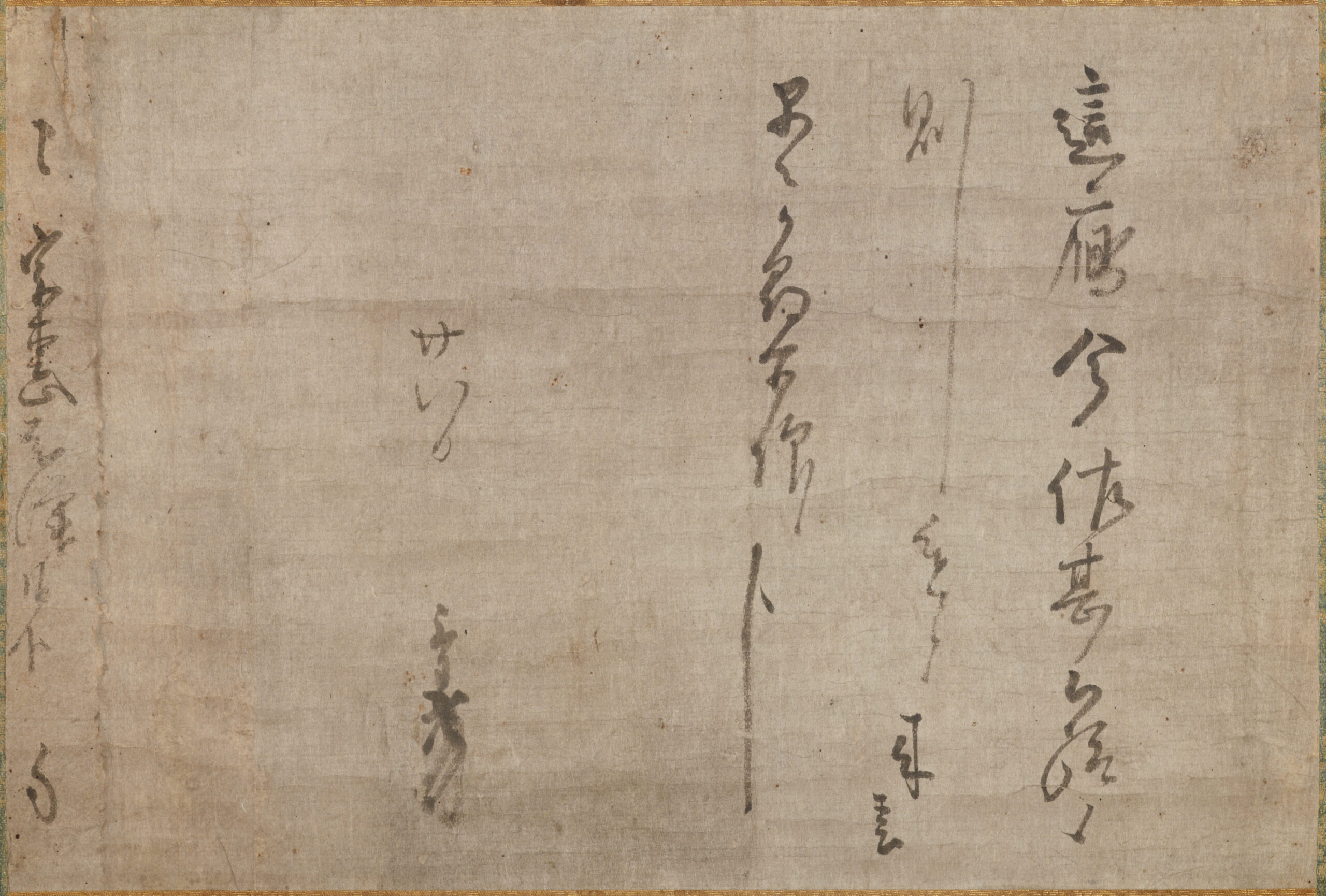
Letter attributed to Takeno Jōō, Muromachi period (16th century).
Collection: Tokyo National Museum.
Source: ColBase (National Institutes for Cultural Heritage, Japan).
Object ID: B-2944.
License: CC BY 4.0.
Letters matter here because they show how tea practice is woven into exchange. They indicate scheduling, contact, and
continuity. They also remind us that “tea culture” in Sakai was not only a set of ideals. It was an operational domain embedded
in communication and trust, which fits the idea of stabilization rather than invention.
Letter by Sen no Rikyū to Sōkei, Azuchi–Momoyama period (16th century).
Collection: Tokyo National Museum.
Source: ColBase (National Institutes for Cultural Heritage, Japan).
Object ID: B-3393.
License: CC BY 4.0.
Later correspondence by Rikyū illustrates how tea gatherings continued to function within networks shaped in Sakai. This is not
presented as a simple master–disciple proof. It is presented as a continuity signal: tea practice remains embedded in
communication circuits, and its legitimacy depends on shared recognition within connected circles. That continuity helps
explain how later intensification could occur without rebuilding the practice from zero.
5. Transition Toward Rikyū
The sequence from Jukō to Jōō to Rikyū forms a structural progression. Jukō compressed scale and recalibrated value
orientation. Jōō stabilized that compressed form within Sakai’s merchant networks by making it reproducible, legible, and
socially functional. Rikyū later intensified internal tension by tightening spatial constraint, sharpening selection, and
amplifying the ethical pressure of the gathering.
Intensification becomes visible only after stabilization is achieved. A format must first be repeatable across households
before it can be tightened into a more demanding form. In this progression, Jōō occupies the critical middle position. He made
compression sustainable inside a credit-based urban society where reliability and shared recognition mattered as much as taste.
Conclusion
Takeno Jōō did not need to invent tea practice. He needed to make it work. He stabilized compressed tea as a repeatable urban
format inside Sakai’s merchant networks. That stabilization is what made later intensification possible.
References
Kumakura, I. (2001). Furuta Oribe to Momoyama no Cha. Tankōsha.
Kumakura, I. (Ed.). (1989/1994). Chanoyu: The Urasenke Tradition of Tea (English ed.). Weatherhill. (For institutional context and practice structure.)
Sadler, A. L. (1933). Cha-no-yu: The Japanese Tea Ceremony. Tuttle. (Classic English-language overview; use selectively.)
ColBase (National Institutes for Cultural Heritage, Japan). Object records: E-20001, G-5373, B-2944, B-3393.
Murata Jukō (1423–1502) did not invent tea, nor did he introduce discipline into it. By the fifteenth century, tea in Japan had already passed through phases of institutional stabilization and repeatable form, as outlined in Japanese Tea Practice Formation. The Zen intensification that preceded him, particularly in the Muromachi period, is examined in Ikkyū Sōjun – Zen Reconfiguration. Jukō’s significance lies in structural reconfiguration. He compressed scale, recalibrated value, and demonstrated that disciplined tea practice could survive outside large institutional frameworks.
Portrait of Murata Jukō (attributed), Muromachi period (15th century).
Source: Wikimedia Commons.
License: Public Domain.
File name: Murata_Juko.PNG.
1. What He Inherited
By Jukō’s lifetime, tea had already moved through court ceremony and Zen monastic regulation. It had acquired hierarchical recognition, textual legitimation, and stable repetition. Higashiyama culture further reinforced the prestige of imported Chinese objects (karamono), embedding tea within a visible hierarchy of rank and possession.
Tea was not undefined. It was structured. Jukō entered an already stabilized cultural system, yet one in which Zen interiorization had begun to reshape evaluation criteria.
2. The Problem of Display
In elite gatherings, the display of prestigious objects often structured attention. Value attached to rarity, provenance, and demonstrable authority. Tea could function as a medium through which hierarchy was reaffirmed.
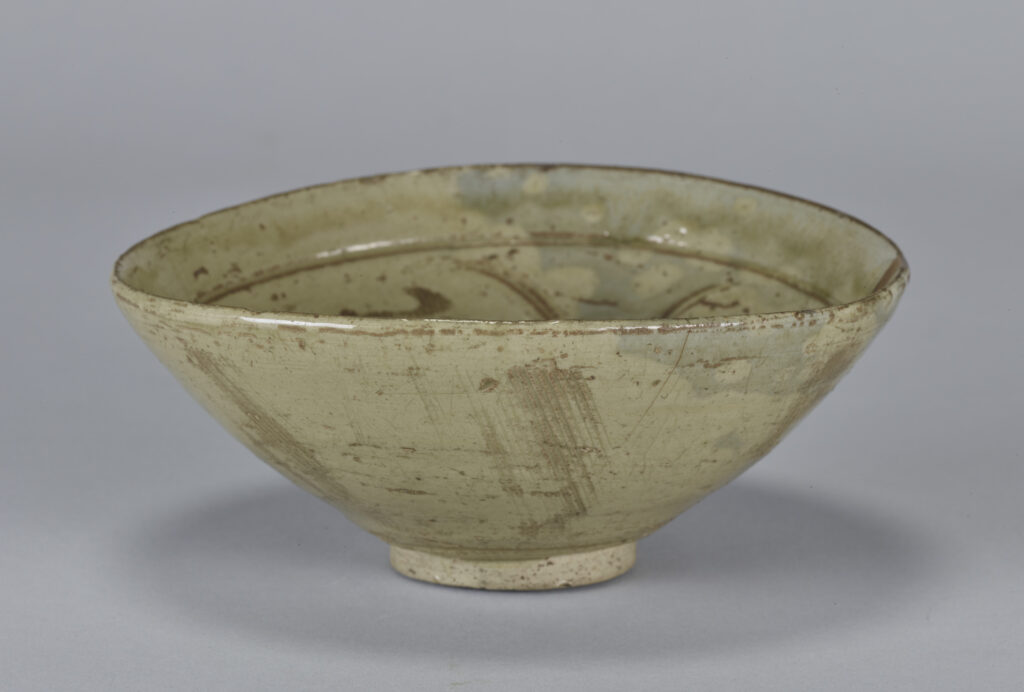
Jukō did not reject imported objects outright. Evidence suggests appreciation for restrained Chinese wares, including celadon associated with Longquan kilns. The shift was selective rather than oppositional.
Celadon tea bowl (Southern Song dynasty, 12th–13th century), Longquan kiln tradition.
Collection: Tokyo National Museum.
Source: ColBase (National Institutes for Cultural Heritage, Japan).
License: CC BY 4.0 (use with attribution).
Object record: TG-431 / E0103549.
Such objects occupied a moderated position within the existing hierarchy. Jukō’s contribution was not aesthetic rejection but recalibration. Value shifted from demonstrable prestige toward relational proportion and restraint. Display was compressed into a tighter structural field.
3. Compression and Reassignment
One structural adjustment associated with Jukō was scale compression. Larger reception spaces gradually yielded to smaller, controlled environments. Fewer objects were displayed. Selection became deliberate.
Compression intensifies attention. Reduction clarifies relational structure. Form was not abolished. It was subordinated to internal criterion.
“If it accords with the heart, form will follow.” — Attributed to Murata Jukō, Jukō Chawa.
Read structurally, this statement does not eliminate form. It repositions form as responsive rather than dominant. Zen discourse destabilized rigid attachment to form; Jukō embedded that recalibration into the material grammar of tea.
4. Discipline Without the Monastery
Earlier tea practice gained stability through institutions. Court ritual and monastic schedules provided regulated frameworks.
Jukō demonstrated that disciplined form could survive outside such structures. A small room could function as a micro-institution. Within it, gesture, object placement, and silence structured attention. Structural discipline became portable.
Zen calligraphy “Kyōge betsuden / Furyū monji” (Muromachi period, 15th century), attributed to Ikkyu Sōjun.
Collection: Tokyo National Museum.
Source: ColBase (National Institutes for Cultural Heritage, Japan).
Object ID: B-2944.
License: CC BY 4.0 (use with attribution).
The tension between form and direct experience, articulated within Muromachi Zen discourse, provided a broader cultural climate. Jukō translated this tension into spatial and object selection logic. Compression replaced expansive display as the dominant structural move.
5. Limited Institutionalization
Jukō did not establish a large, enduring school during his lifetime. His transmission appears mediated through figures such as Takeno Jōō. The later label “founder of wabi tea” simplifies a layered historical process.
His role was transitional. He altered scale and value orientation, but later systematization occurred in subsequent generations. The recalibration he initiated required further consolidation.
6. Toward Rikyū
If Jukō compressed scale and recalibrated value, Sen no Rikyū radicalized compression and intensified structural coherence. The movement is one of structural intensification, not invention followed by completion.
Jukō did not create tea. He reconfigured its architecture. Within the structural sequence of formation → Zen intensification → compression, his position marks the decisive narrowing that made later coherence possible.
References
Benn, James A. (2015). Tea in China: A Religious and Cultural History. University of Hawai‘i Press.
Kumakura, Isao (2018). History of Tea in Japan.
Murai, Yasuhiko (2012). Murata Jukō to Wabi no Hakken. Tankōsha.
ColBase (National Institutes for Cultural Heritage, Japan), object records: TG-431, B-2944.
Japanese tea practice did not begin as a refined aesthetic art. Instead, it formed inside institutions. Court ritual, Buddhist monastic regulation, and Zen discipline gave tea a structured and repeatable form. This article explains how Japanese tea practice developed through these institutional environments and became a transferable cultural system.
At first, tea appeared in limited ceremonial contexts. However, once institutions incorporated tea into regulated space, repetition gave it durability. As a result, Japanese tea practice gained structural stability rather than remaining an occasional custom. The next structural transformation is examined in Ikkyū Sōjun and the Zen Transformation of Tea Practice, where Zen discourse intensifies meaning within established form.
How Japanese Tea Practice Entered Court Ritual
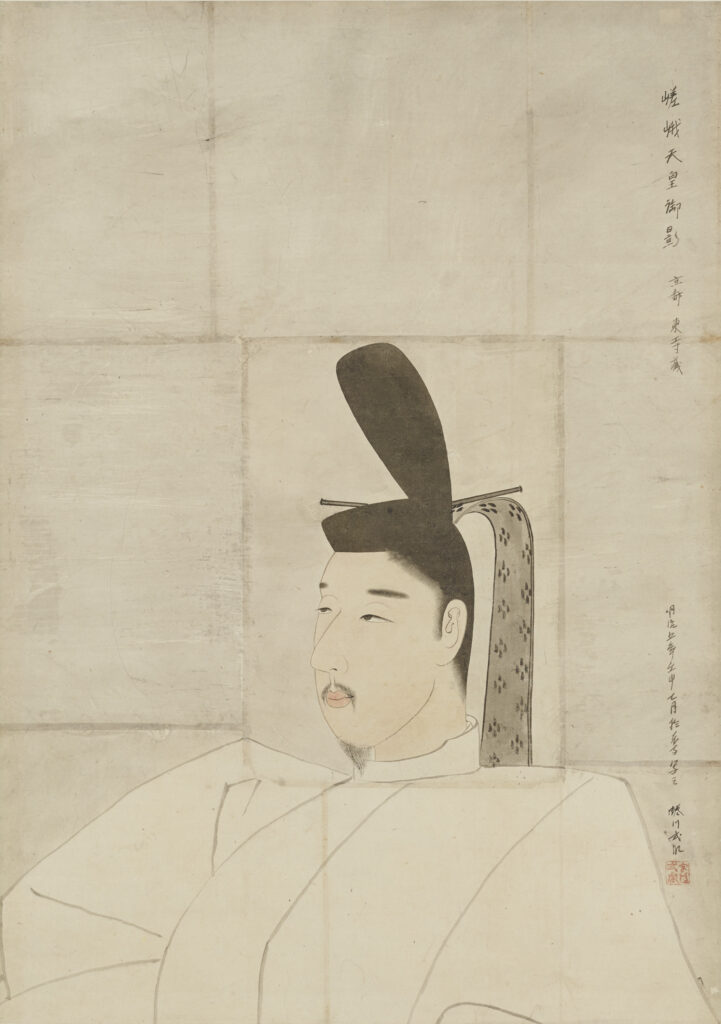
A well-known entry in Nihon Kōki (812) records the monk Eichū preparing and offering tea to Emperor Saga. Although the text does not describe preparation in detail, it demonstrates that tea functioned inside imperial ceremony. Court ritual incorporated tea into formal hierarchy, thereby granting it institutional recognition.
This episode does not create direct continuity with later tea culture. Nevertheless, it shows that tea could operate within ordered authority. In this way, Japanese tea practice began its institutional formation within ceremonial space.
Portrait of Emperor Saga (later copy), copied by Ninagawa Noritane (1872).
Collection: Tō-ji Temple (Japan).
Source: ColBase (National Institutes for Cultural Heritage).
License: CC BY 4.0.
How Zen Monasteries Stabilized Japanese Tea Practice
Zen monasteries provided disciplined repetition. Monastic life operated through scheduled routines, regulated movement, and shared authority. Consequently, tea could align with existing patterns of practice. Rather than remaining casual consumption, tea entered a cycle of repetition.
Repetition produces stability. When monks prepared and served tea within fixed settings, Japanese tea practice acquired reproducible structure. At the same time, Zen training emphasized attention and embodied action. Therefore, tea became compatible with Zen discipline not only functionally but structurally.
Textual Transmission and Institutional Expansion
Transmission further strengthened institutionalization. Monks traveled between Japan and Song China, carrying both tea knowledge and religious texts. Works such as Kissa Yōjōki described tea’s physical and mental benefits, thereby providing written support for adoption. Because tea could be explained and justified, institutions could incorporate it systematically.
Commercial exchange also played a role. Trade networks transported tea leaves and utensils, connecting monastic and elite environments. As a result, Japanese tea practice expanded across institutional boundaries while retaining structural coherence.
Portrait of Myōan Eisai (1141–1215).
Source: Wikimedia Commons.
License: Public Domain.
From Drinking Tea to Structured Japanese Tea Practice
The decisive shift in Japanese tea practice formation is structural rather than aesthetic. Tea becomes a practice when it gains a stable setting, repeatable form, and shared recognition. Court ritual provided ceremonial framing, Zen monasteries provided disciplined repetition, and texts supplied conceptual support. Together, these elements allowed Japanese tea practice to be learned and transmitted.
Importantly, tea did not merely enter religious space. Instead, it acquired ritual structure, which made it transferable across institutions. By the late medieval period, Japanese tea practice possessed sufficient internal coherence to move beyond strictly monastic environments without losing structural identity.
Bridge to the Zen Reconfiguration
Once Japanese tea practice achieved institutional form, the next transformation concerned meaning within that form. Zen discourse intensified attention and reoriented the relationship between structure and experience. This transition is explored in Ikkyū Sōjun and the Zen Transformation of Tea Practice, where disciplined repetition becomes a template for internal recalibration.
References
Benn, J. A. (2015). Tea in China: A Religious and Cultural History. University of Hawai‘i Press.
Kumakura, I. (2018). History of Tea in Japan.
Nihon Kōki (812), entry referencing Eichū’s offering of tea.
Eisai. (1211). Kissa Yōjōki.
ColBase (National Institutes for Cultural Heritage), object record for Emperor Saga portrait.
Ikkyu Sōjun is often remembered through colorful anecdotes, yet his deeper significance lies elsewhere.
He sharpened a tension within Zen: the tension between institutional form and direct experience.
That tension later became a reusable resource for cultural practices beyond the monastery, including the disciplined world of tea.
Calligraphy in One Line: “Kyōge betsuden / Furyū monji”
(Muromachi period, 15th century), attributed to Ikkyu Sōjun.
Collection: Tokyo National Museum.
Source: ColBase (National Institutes for Cultural Heritage).
Object ID: B-2944. ColBase record.
1. The Problem of Form
Every stable institution depends on repetition. Repetition produces authority, and authority produces recognizable form.
Zen monasteries of the Muromachi period were no exception.
Yet stability carries a risk. Form can begin to replace encounter, and language can begin to replace realization.
When this shift occurs, the system protects itself rather than the experience it was meant to guard.
Ikkyu’s importance lies in how sharply he exposed this risk.
He did not merely criticize institutions.
He reasserted the primacy of direct insight, and he did so from within the institutional world.
2. “Outside the Scriptures” Reconsidered
The phrase commonly translated as “a special transmission outside the scriptures, not dependent on words and letters” has often been treated as a slogan.
In structural terms, however, it functions differently.
It places a constraint on explanation and reminds the practitioner that doctrinal clarity is not the same as lived clarity.
This does not abolish language; it reframes its role.
Words may point and stabilize memory, but they must not replace encounter.
3. Institutional Tension as Correction
Cultural systems rarely change through rejection alone.
They change through tension.
When formal stability grows rigid, a corrective pressure may emerge.
Ikkyu can be understood as one such pressure.
His writings and reputation emphasized immediacy, sincerity, and experiential clarity.
This emphasis did not dismantle Zen institutions; instead, it recalibrated the meaning of practice.
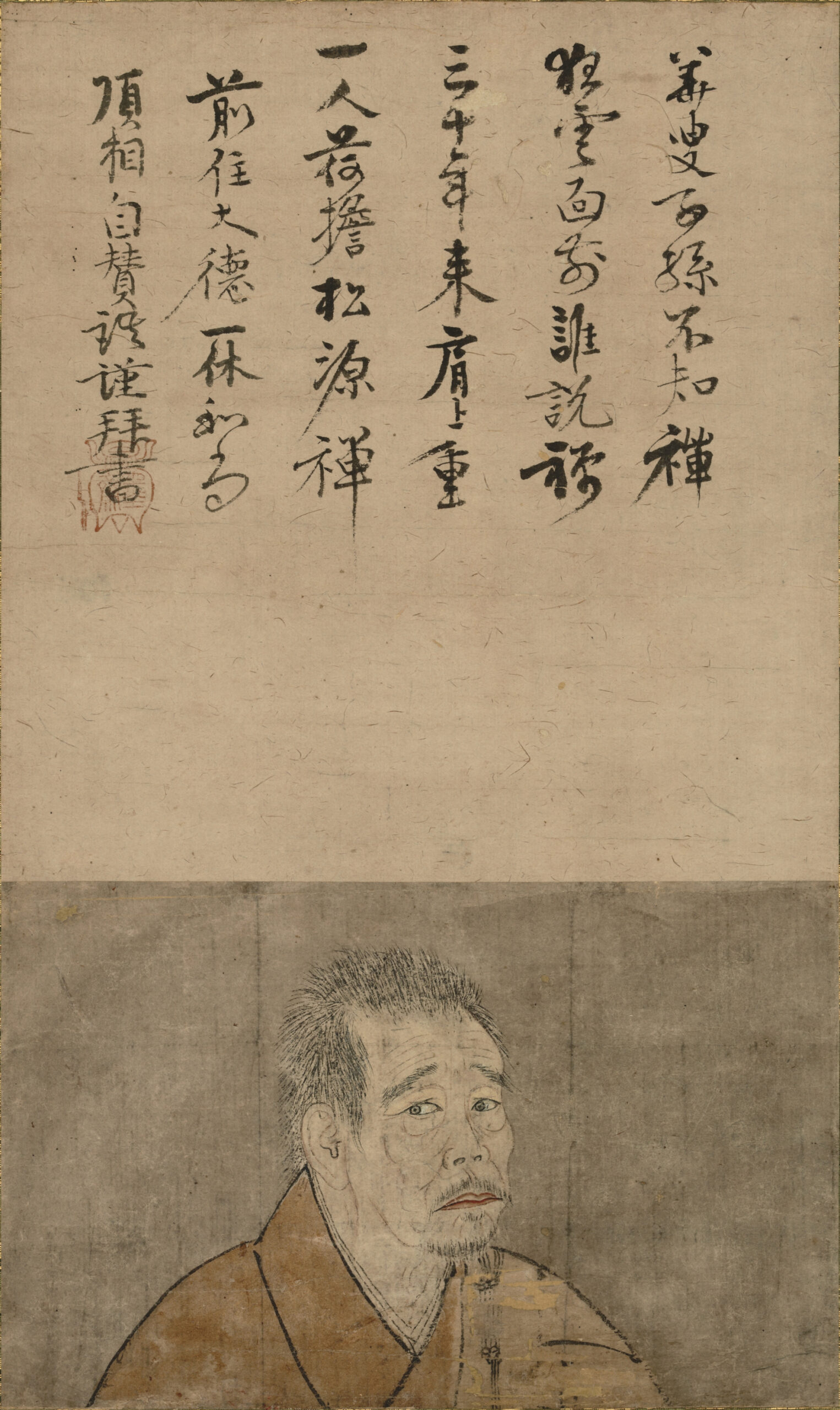
The Zen Monk Ikkyu
(Muromachi period, 15th century).
Collection: Tokyo National Museum.
Source: ColBase (National Institutes for Cultural Heritage).
Object ID: A-10137. ColBase record.
4. Experience and Restraint
It would be simplistic to describe Ikkyu as anti-form.
Direct experience does not negate structure; it limits its authority.
In this sense, form becomes protective rather than performative.
It creates conditions for attention without claiming to be the goal itself.
This recalibration is crucial.
It transforms rebellion into discipline and converts tension into a method.
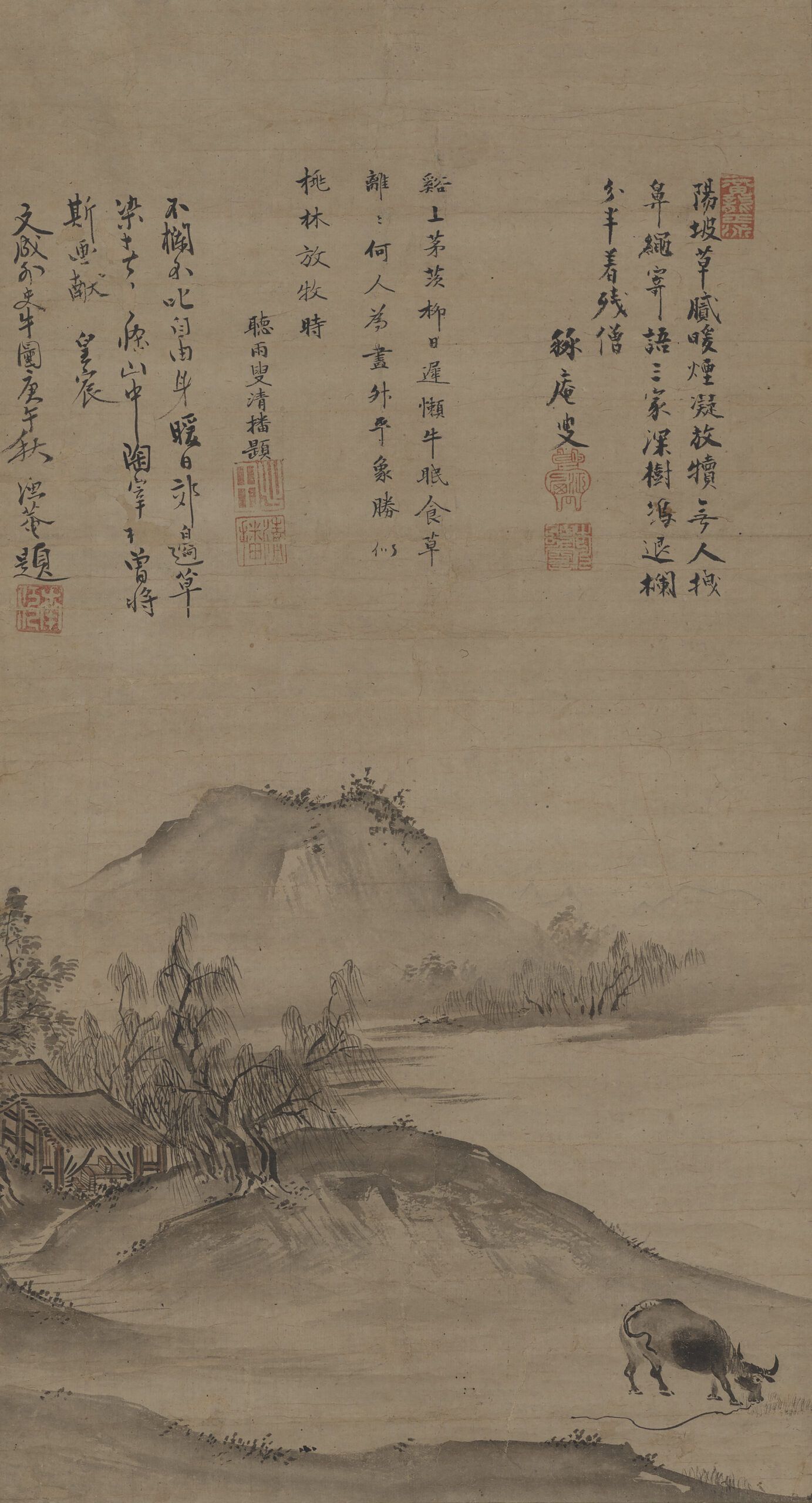
Hōgyūzu (Letting an Ox Graze)
(Muromachi period, 15th century).
Collection: Kyoto National Museum.
Source: ColBase (National Institutes for Cultural Heritage).
Object ID: A甲363. ColBase record.
5. Why This Matters Beyond Zen
The significance of Ikkyu extends beyond monastic history.
By sharpening the contrast between form and experience, he generated a transferable principle.
Later cultural practices, including tea, would depend heavily on form: gesture, sequence, spatial arrangement.
Yet the strongest versions of tea do not treat these forms as ends in themselves.
They function as frames for attention and protect the moment of encounter.
In this way, a tension articulated within Zen became a stabilizing resource elsewhere.
6. Toward Jukō and the Reconfiguration of Tea
The tension that Ikkyu Sōjun clarified within Zen did not remain confined to the monastery.
It entered the cultural bloodstream of late Muromachi Japan.
When Murata Jukō later reformulated tea practice, he did not simply invent a new aesthetic.
He inherited a sharpened awareness of form and direct experience — an awareness that Ikkyu had made unavoidable.
In this sense, the transformation of tea cannot be understood without first recognizing the recalibration that occurred within Zen.
References
ColBase (National Institutes for Cultural Heritage, Japan). “Calligraphy in One Line” (B-2944), Tokyo National Museum.
ColBase (National Institutes for Cultural Heritage, Japan). “The Zen Monk Ikkyu” (A-10137), Tokyo National Museum.
ColBase (National Institutes for Cultural Heritage, Japan). “Hōgyūzu (Letting an Ox Graze)” (A甲363), Kyoto National Museum.