Murata Jukō (1423–1502) did not invent tea, nor did he introduce discipline into it. By the fifteenth century, tea in Japan had already passed through phases of institutional stabilization and repeatable form, as outlined in Japanese Tea Practice Formation. The Zen intensification that preceded him, particularly in the Muromachi period, is examined in Ikkyū Sōjun – Zen Reconfiguration. Jukō’s significance lies in structural reconfiguration. He compressed scale, recalibrated value, and demonstrated that disciplined tea practice could survive outside large institutional frameworks.
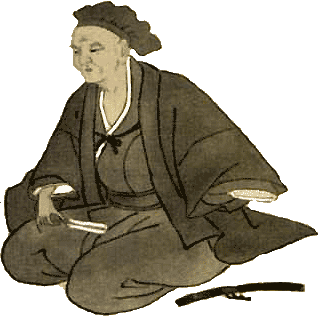
Source: Wikimedia Commons.
License: Public Domain.
File name: Murata_Juko.PNG.
1. What He Inherited
By Jukō’s lifetime, tea had already moved through court ceremony and Zen monastic regulation. It had acquired hierarchical recognition, textual legitimation, and stable repetition. Higashiyama culture further reinforced the prestige of imported Chinese objects (karamono), embedding tea within a visible hierarchy of rank and possession.
Tea was not undefined. It was structured. Jukō entered an already stabilized cultural system, yet one in which Zen interiorization had begun to reshape evaluation criteria.
2. The Problem of Display
In elite gatherings, the display of prestigious objects often structured attention. Value attached to rarity, provenance, and demonstrable authority. Tea could function as a medium through which hierarchy was reaffirmed.
Jukō did not reject imported objects outright. Evidence suggests appreciation for restrained Chinese wares, including celadon associated with Longquan kilns. The shift was selective rather than oppositional.
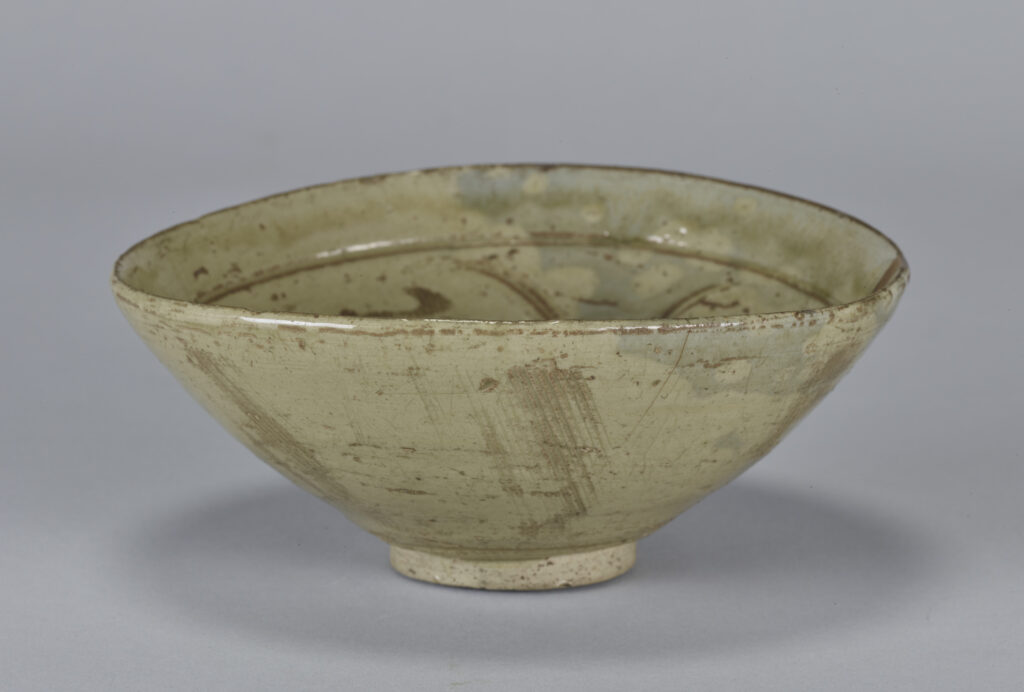
Collection: Tokyo National Museum.
Source: ColBase (National Institutes for Cultural Heritage, Japan).
License: CC BY 4.0 (use with attribution).
Object record: TG-431 / E0103549.
Such objects occupied a moderated position within the existing hierarchy. Jukō’s contribution was not aesthetic rejection but recalibration. Value shifted from demonstrable prestige toward relational proportion and restraint. Display was compressed into a tighter structural field.
3. Compression and Reassignment
One structural adjustment associated with Jukō was scale compression. Larger reception spaces gradually yielded to smaller, controlled environments. Fewer objects were displayed. Selection became deliberate.
Compression intensifies attention. Reduction clarifies relational structure. Form was not abolished. It was subordinated to internal criterion.
“If it accords with the heart, form will follow.” — Attributed to Murata Jukō, Jukō Chawa.
Read structurally, this statement does not eliminate form. It repositions form as responsive rather than dominant. Zen discourse destabilized rigid attachment to form; Jukō embedded that recalibration into the material grammar of tea.
4. Discipline Without the Monastery
Earlier tea practice gained stability through institutions. Court ritual and monastic schedules provided regulated frameworks.
Jukō demonstrated that disciplined form could survive outside such structures. A small room could function as a micro-institution. Within it, gesture, object placement, and silence structured attention. Structural discipline became portable.

Collection: Tokyo National Museum.
Source: ColBase (National Institutes for Cultural Heritage, Japan).
Object ID: B-2944.
License: CC BY 4.0 (use with attribution).
The tension between form and direct experience, articulated within Muromachi Zen discourse, provided a broader cultural climate. Jukō translated this tension into spatial and object selection logic. Compression replaced expansive display as the dominant structural move.
5. Limited Institutionalization
Jukō did not establish a large, enduring school during his lifetime. His transmission appears mediated through figures such as Takeno Jōō. The later label “founder of wabi tea” simplifies a layered historical process.
His role was transitional. He altered scale and value orientation, but later systematization occurred in subsequent generations. The recalibration he initiated required further consolidation.
6. Toward Rikyū
If Jukō compressed scale and recalibrated value, Sen no Rikyū radicalized compression and intensified structural coherence. The movement is one of structural intensification, not invention followed by completion.
Jukō did not create tea. He reconfigured its architecture. Within the structural sequence of formation → Zen intensification → compression, his position marks the decisive narrowing that made later coherence possible.
References
- Benn, James A. (2015). Tea in China: A Religious and Cultural History. University of Hawai‘i Press.
- Kumakura, Isao (2018). History of Tea in Japan.
- Murai, Yasuhiko (2012). Murata Jukō to Wabi no Hakken. Tankōsha.
- ColBase (National Institutes for Cultural Heritage, Japan), object records: TG-431, B-2944.
- Wikimedia Commons, “Murata_Juko.PNG” (Public Domain).