Takeno Jōō (1502–1555) and Sakai Tea Culture
Takeno Jōō (1502–1555) is best understood as a structural stabilizer. Murata Jukō compressed tea practice into a smaller,
portable form. Jōō made that compression socially sustainable inside Sakai, an urban merchant environment organized through
exchange, credit, and repeatable interaction. He did not found an aesthetic school. He stabilized a workable format within a
networked city.
This essay sits within The Formation of Japanese Tea Practice.
It follows Murata Jukō and prepares the ground for Sen no Rikyū.
The main claim is simple. Jōō made compressed tea repeatable in a merchant world. He made it usable as a social instrument.
This was structural stabilization.
1. Takeno Jōō and Sakai Tea Culture
In the sixteenth century, Sakai functioned as an autonomous merchant city with strong maritime connections. Authority depended
less on court rank than on commercial reputation and negotiated order. In such an environment, trust required visible and
repeatable signals of reliability. Tea gatherings operated as one such signal within merchant networks.

Source: Wikimedia Commons.
License: Public Domain.
File: Takeno_Jouou.jpg.
Sakai’s merchant networks depended on credit, and credit depended on predictability. Transactions were not secured only by
formal state enforcement. They were secured by reputation, reciprocal obligation, and the ongoing monitoring of behavior within
dense circles. Reliability could not remain a private claim. It had to be confirmed through repeated encounters and shared
evaluation.
Tea gatherings provided a controlled format for such confirmation. They were not simply leisure events. They were small-scale
institutions that regulated attention, pacing, and conduct. The constraints of the setting reduced the noise of everyday
commerce and made social signals more legible. Hosting skill, appropriate selection, and maintained order under constraint
functioned as a public demonstration of competence.
This helps explain why Jōō matters structurally. Compression could survive outside monastic authority only if it became legible
and repeatable across households. A reduced format must be teachable, replicable, and recognized as “proper” by people who share
no court hierarchy. Jōō’s stabilization is the mechanism that made compressed tea compatible with Sakai’s credit-based urban
system.
2. Compression Inside Merchant Culture
Tea in Sakai developed among merchants who had access to imported wares and recognized prestige objects. Reduction therefore
functioned as deliberate moderation within abundance rather than as an expression of scarcity. By narrowing comparison and
tightening selection, compression stabilized interaction inside competitive networks. What later generations labeled “early wabi
tea” can be read structurally as selected moderation within an urban economy.
A merchant environment can treat objects as both cultural signals and transferable assets. Imported items, celebrated utensils,
and named pieces could circulate through gifting, purchase, pledge, or mediated exchange. This creates a problem for gathering
design. If a tea meeting becomes a pure arena of display, it increases rivalry and undermines the stability of relationships the
network depends on. Compression offers a practical response. It limits the field of display and shifts evaluation toward
proportion and suitability.
Moderation also protects meaning. When only a small number of items enter the room, each selection becomes consequential, and
the host must justify it through coherence rather than through price or provenance alone. The setting encourages a type of
judgment that fits urban coordination: stable criteria, shared expectations, and reduced volatility. The point is not moral
austerity. The point is operational stability inside Sakai tea culture.
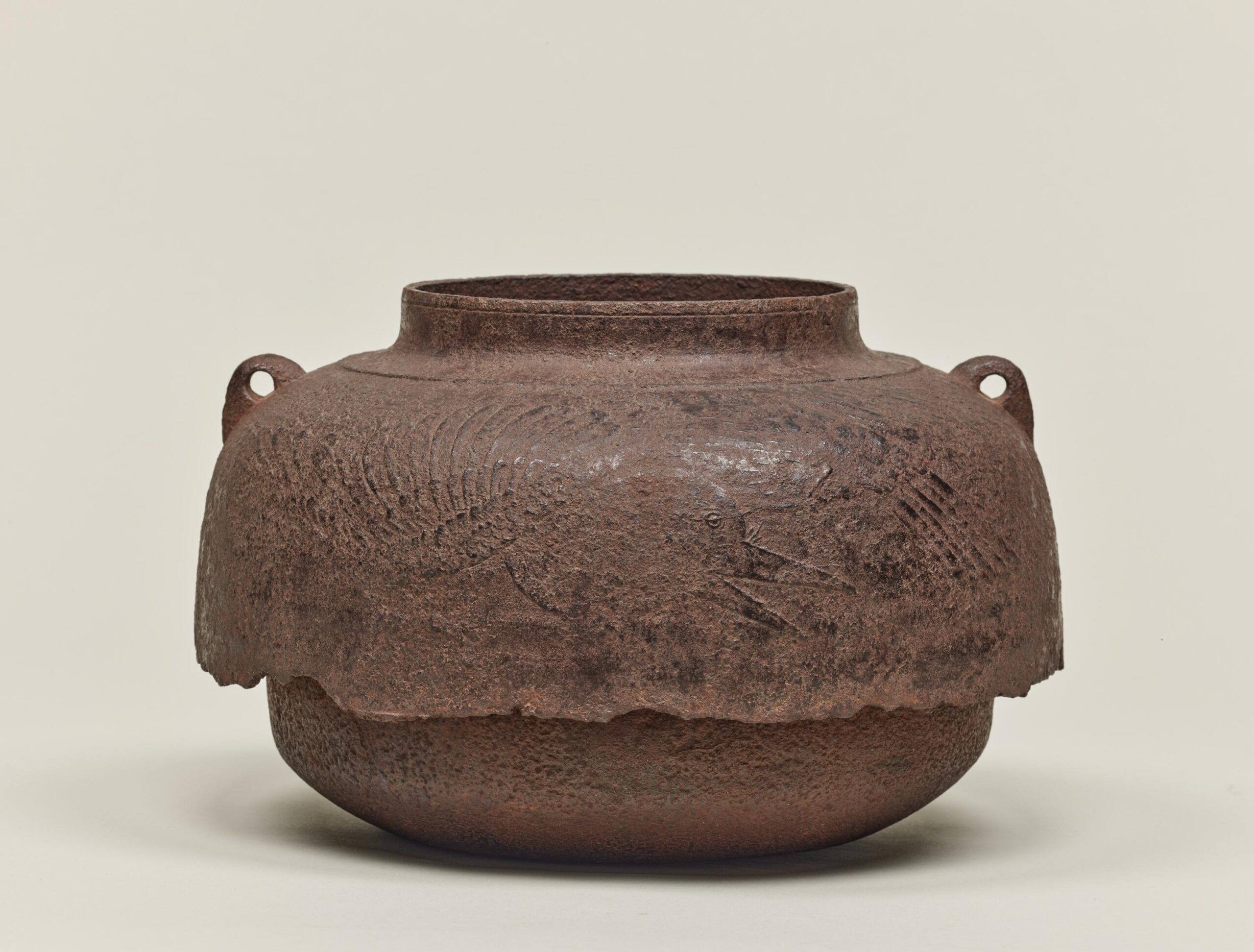
Collection: Tokyo National Museum.
Source: ColBase (National Institutes for Cultural Heritage, Japan).
Object ID: E-20001.
License: CC BY 4.0.
Objects associated with elite circulation could still appear within moderated gatherings, but their function changes. Rather
than dominating attention as trophies, they become components inside a calibrated system of selection. This is consistent with
Jōō’s position as a stabilizer: not rejecting prestige objects outright, but embedding them inside a reduced and regulated
format where they support coordination rather than destabilize it.
3. Formal Refinement as Stabilization
Jōō’s contribution can be described as formal refinement that made compression operational. Stabilization required repeatable
sequence, recognizable proportion, and a functional object hierarchy. Refinement here indicates calibration rather than luxury.
By reducing contested decisions and clarifying what must remain constant, Jōō helped make compressed tea reproducible within
Sakai’s networks.
A compressed gathering fails when it becomes ambiguous. If utensils appear without clear ordering, if pacing shifts without
shared expectation, or if criteria of selection change unpredictably, the room becomes a site of disagreement. In a credit-based
society, disagreement has cost. It weakens trust and increases friction across future transactions. Stabilization therefore has
a practical aim: to minimize uncertainty by standardizing what participants can reasonably expect.
This is where “form” becomes a stabilizing technology. A repeatable sequence organizes attention. Recognizable proportion limits
interpretive conflict. A functional hierarchy of objects prevents confusion about what matters at each moment. The host’s
competence becomes measurable, and the guests’ evaluation becomes more consistent. These conditions allow the practice to scale
across households without requiring a central institution to police correctness.
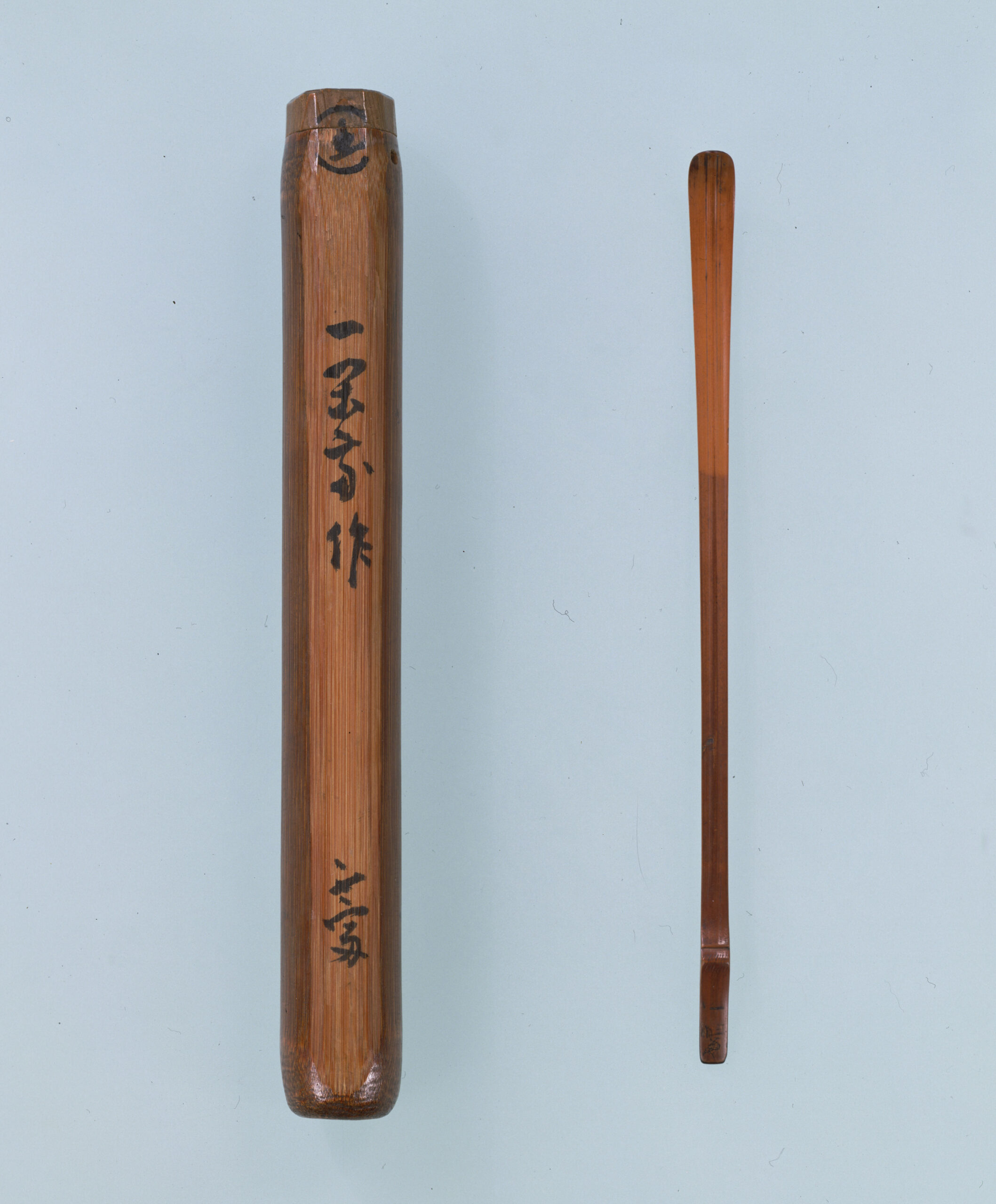
Collection: Tokyo National Museum.
Source: ColBase (National Institutes for Cultural Heritage, Japan).
Object ID: G-5373.
License: CC BY 4.0.
A bamboo tea scoop is a useful structural symbol because it is not impressive by scale or material, yet it is decisive in
practice. It participates in proportional calibration and in repeatable handling. When such objects become standardized within
circles, they reinforce a shared grammar of action. In that sense, the stabilization of small implements supports the
stabilization of the gathering as a whole.
4. Documentary Evidence in Merchant Communication
Surviving documents attributed to Jōō provide material evidence of tea practice within merchant communication networks. Letters
demonstrate coordination, exchange, and the practical dimension of gatherings. They anchor stabilization in documented
interaction rather than retrospective aesthetic labeling.
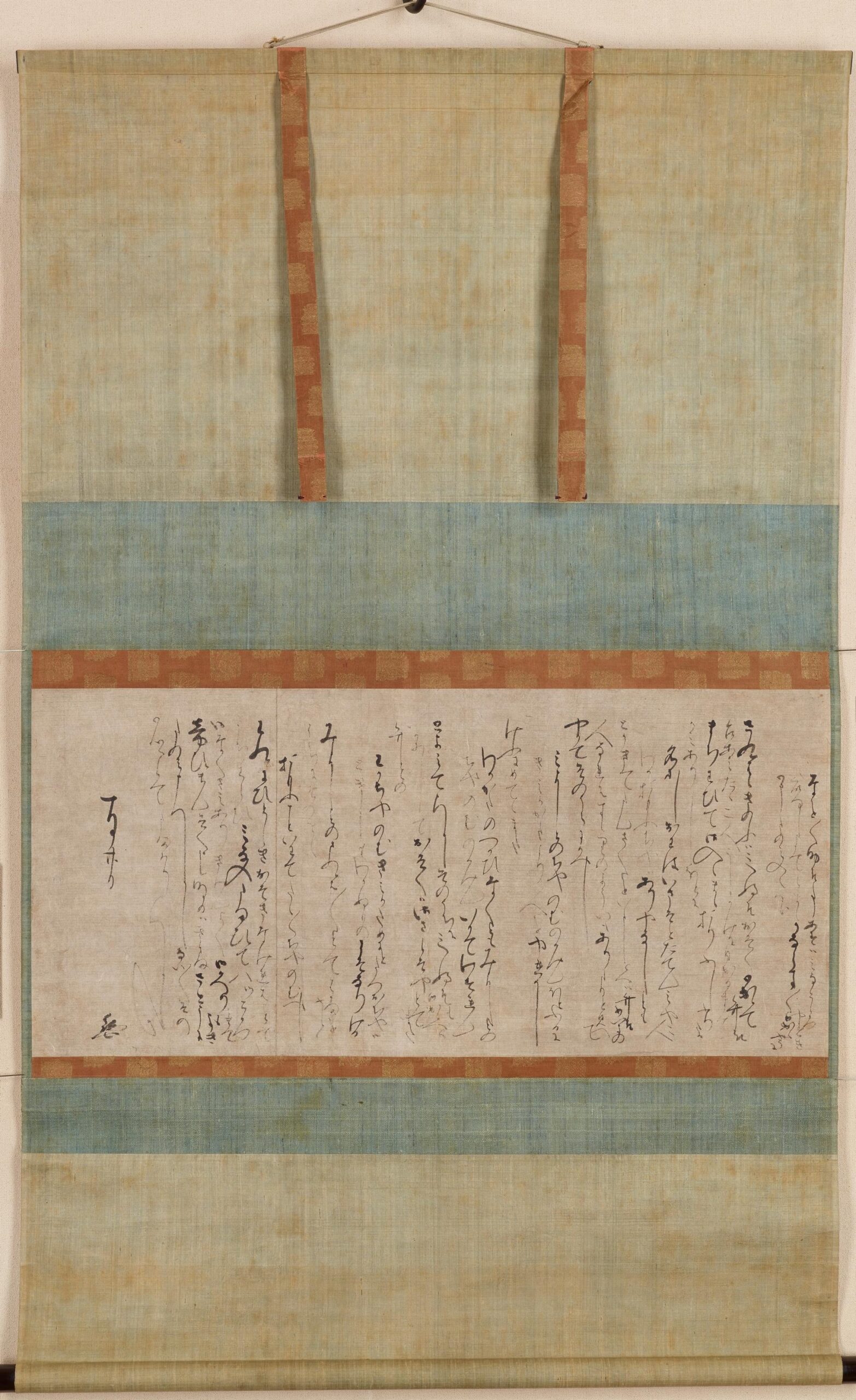
Collection: Tokyo National Museum.
Source: ColBase (National Institutes for Cultural Heritage, Japan).
Object ID: B-2944.
License: CC BY 4.0.
Letters matter here because they show how tea practice is woven into exchange. They indicate scheduling, contact, and
continuity. They also remind us that “tea culture” in Sakai was not only a set of ideals. It was an operational domain embedded
in communication and trust, which fits the idea of stabilization rather than invention.
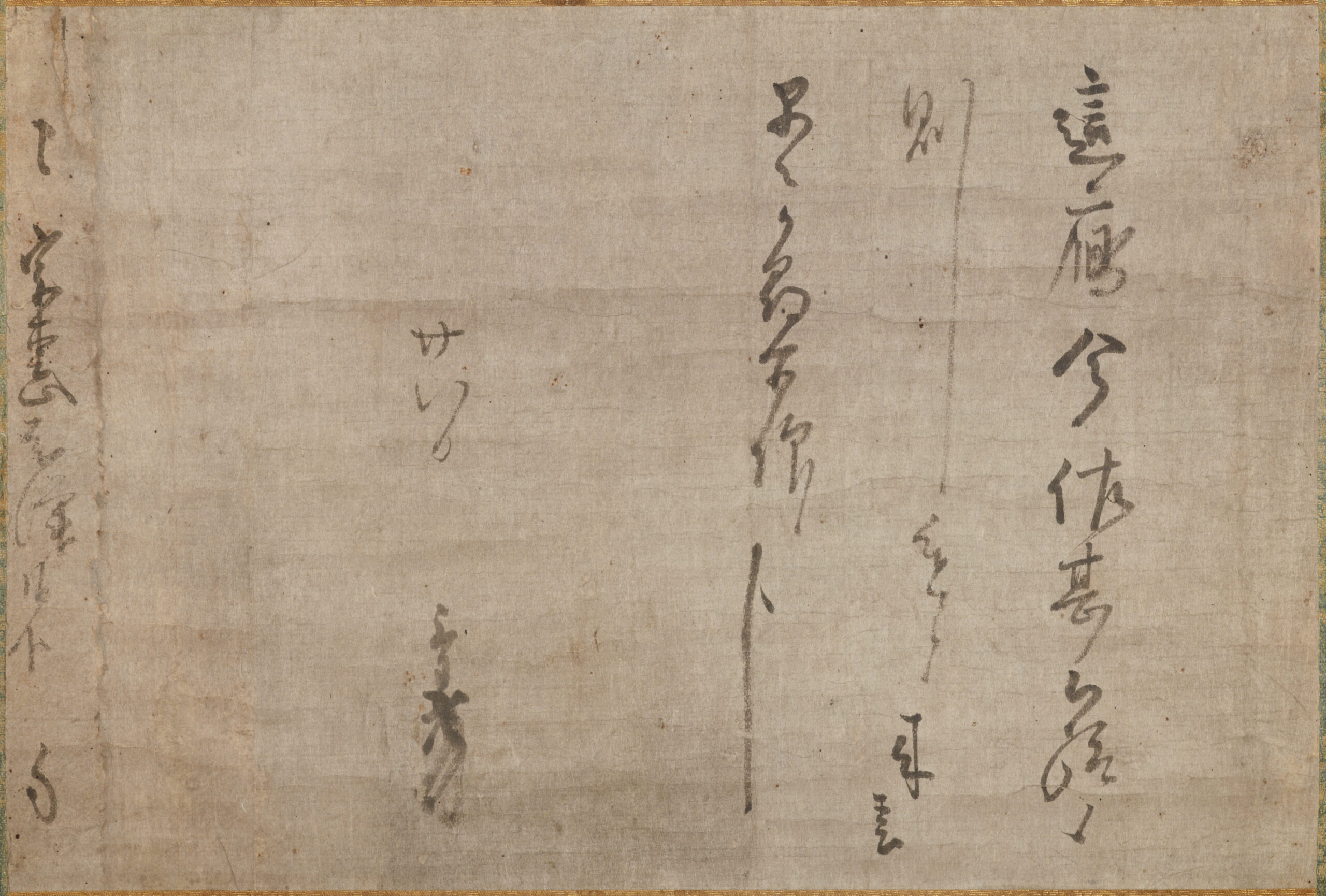
Collection: Tokyo National Museum.
Source: ColBase (National Institutes for Cultural Heritage, Japan).
Object ID: B-3393.
License: CC BY 4.0.
Later correspondence by Rikyū illustrates how tea gatherings continued to function within networks shaped in Sakai. This is not
presented as a simple master–disciple proof. It is presented as a continuity signal: tea practice remains embedded in
communication circuits, and its legitimacy depends on shared recognition within connected circles. That continuity helps
explain how later intensification could occur without rebuilding the practice from zero.
5. Transition Toward Rikyū
The sequence from Jukō to Jōō to Rikyū forms a structural progression. Jukō compressed scale and recalibrated value
orientation. Jōō stabilized that compressed form within Sakai’s merchant networks by making it reproducible, legible, and
socially functional. Rikyū later intensified internal tension by tightening spatial constraint, sharpening selection, and
amplifying the ethical pressure of the gathering.
Intensification becomes visible only after stabilization is achieved. A format must first be repeatable across households
before it can be tightened into a more demanding form. In this progression, Jōō occupies the critical middle position. He made
compression sustainable inside a credit-based urban society where reliability and shared recognition mattered as much as taste.
Conclusion
Takeno Jōō did not need to invent tea practice. He needed to make it work. He stabilized compressed tea as a repeatable urban
format inside Sakai’s merchant networks. That stabilization is what made later intensification possible.
References
- Kumakura, I. (2001). Furuta Oribe to Momoyama no Cha. Tankōsha.
- Kumakura, I. (Ed.). (1989/1994). Chanoyu: The Urasenke Tradition of Tea (English ed.). Weatherhill. (For institutional context and practice structure.)
- Sadler, A. L. (1933). Cha-no-yu: The Japanese Tea Ceremony. Tuttle. (Classic English-language overview; use selectively.)
- ColBase (National Institutes for Cultural Heritage, Japan). Object records: E-20001, G-5373, B-2944, B-3393.
- Wikimedia Commons. “Takeno_Jouou.jpg” (Public Domain).