Sen no Rikyū (1522–1591): The Designer of Value
Situated within The Formation of Japanese Tea Practice, Sen no Rikyū did not invent tea, nor did he merely refine an aesthetic. He redesigned how value operated in sixteenth-century Japan. Through compressed space, recalibrated materials, regulated exchange, and proximity to sovereign authority, he constructed a system in which cultural meaning, economic coordination, and political visibility intersected.
Building upon the stabilizing work of Takeno Jōō, Rikyū intensified structural reduction and transformed chanoyu into a high-density ritual system.

Collection: Masaki Art Museum (Osaka, Japan).
Source: Wikimedia Commons (“Sen no Rikyu (Masaki Art Museum).jpg”).
License: Public Domain (PD-Art).
1. Space as Regulation
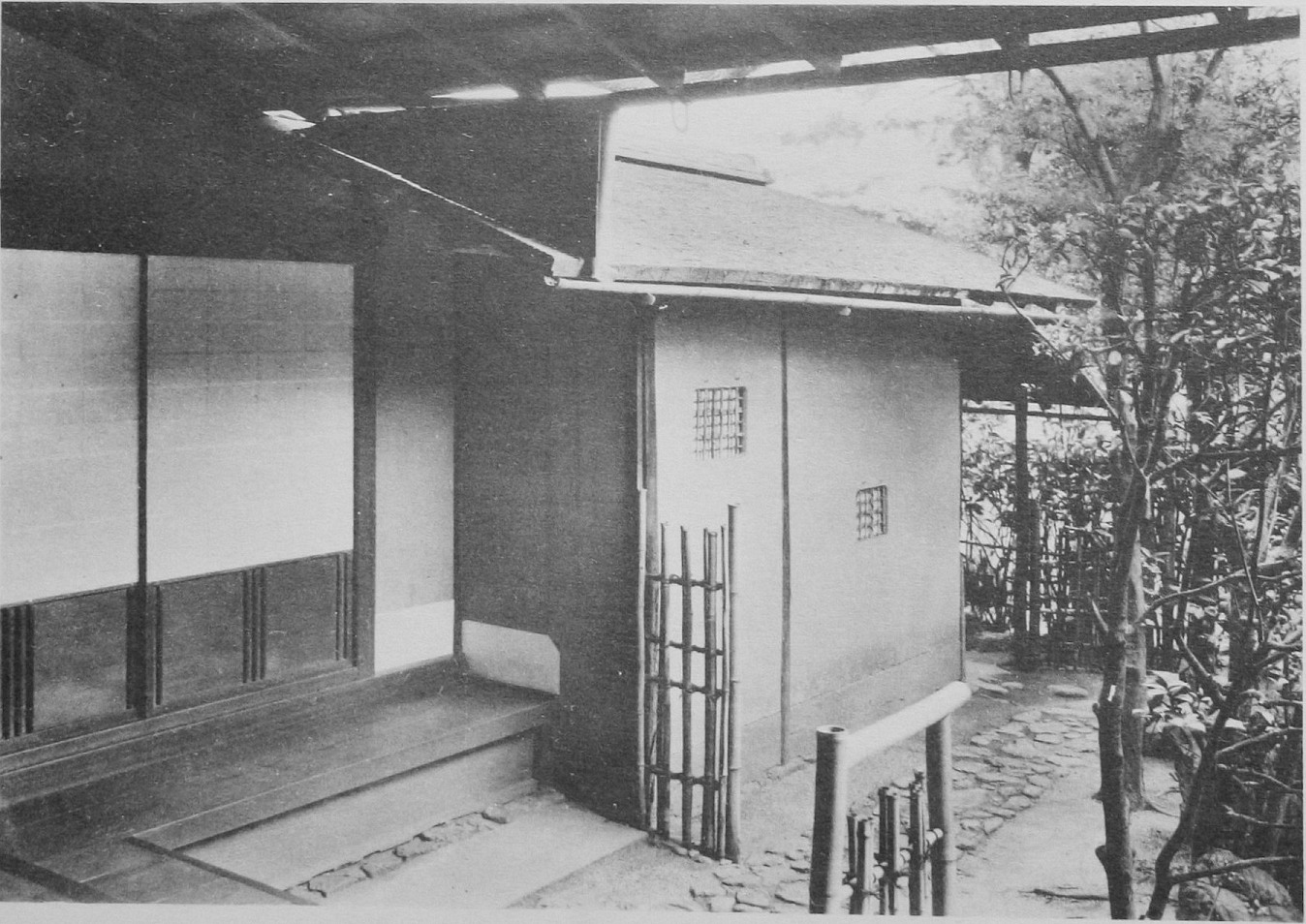
Source: Wikimedia Commons.
License: Public Domain.
Tai-an, the small tea room associated with Rikyū, compresses the body and restricts movement. The two-mat configuration reduces spatial hierarchy. The narrow entrance lowers posture and standardizes entry. Architecture becomes a regulatory device.
This spatial compression intensifies attention. Fewer elements enter the room, and each carries greater weight. The gathering becomes a controlled environment in which selection, pacing, and conduct are legible. Space does not decorate tea; it governs it.
2. Material Revaluation

Aichi Prefectural Ceramic Museum.
Source: Wikimedia Commons.
License: CC BY-SA 4.0.
Working in close association with the potter Chōjirō, Rikyū helped establish the black Raku bowl as a new ceramic form. Unlike imported Chinese wares valued as trophies of political prestige, the Raku bowl was locally produced and hand-formed. Its surface absorbs light rather than reflects it. Irregularity replaces symmetry.
This was not a rejection of value but a redirection of value. Authority moved from rarity and distance to immediacy and embodied use. The bowl centers the act of holding rather than visual admiration.

Sekisui Museum, Mie Prefecture.
Source: Wikimedia Commons.
License: CC BY-SA 4.0.
Bamboo flower vessels traditionally linked to Rikyū extend this revaluation. Simple organic material replaces lacquer and metal. Whether every surviving example is authentic or not, the structural shift is clear: raw material acquires legitimacy within the ritual system.
3. Exchange and Monetary Coordination
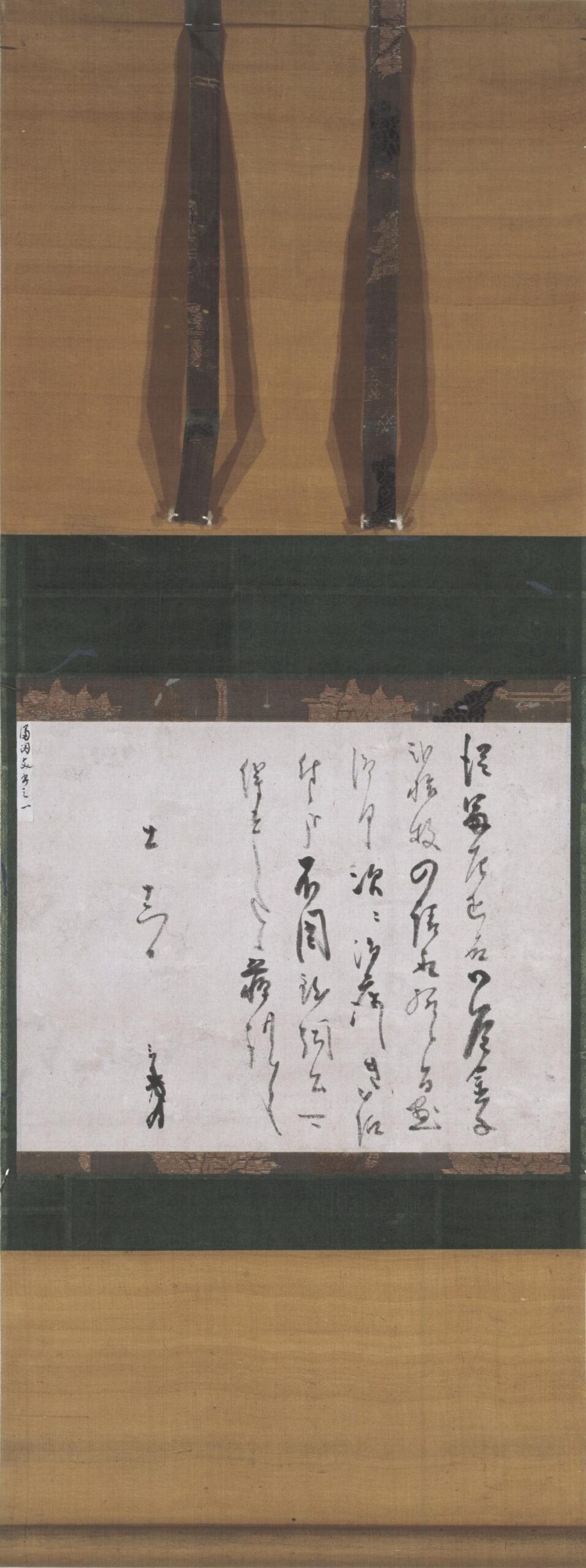
Azuchi–Momoyama period, 16th century.
Collection: Tokyo National Museum.
Source: ColBase (National Institutes for Cultural Heritage, Japan).
Object ID: B-3332.
License: CC BY 4.0.
This letter records monetary terms connected to tea-related exchange. Tea practice operated within financial coordination. Objects were purchased, transferred, and accounted for. Cultural authority required logistical precision.
Rikyū did not stand outside economic circuits. He functioned within merchant and warrior networks in which value moved through documented exchange. The ritual system depended on stable coordination beyond the tearoom.
4. Sovereign Proximity and Tension
Rikyū served Oda Nobunaga and Toyotomi Hideyoshi during a period when prized tea objects were centralized and redistributed. Tea gatherings became sites of sovereign display. Cultural legitimacy and political authority converged.
Rikyū’s system intensified compression under this visibility. Spatial restriction, strict selection, and heightened relational discipline increased the informational density of each gathering. Such a system delivers clarity but reduces tolerance for deviation.
High compression produces high tension. When ritual authority and sovereign authority overlap too closely, fragility increases. The structure becomes powerful yet unstable.
Conclusion
Sen no Rikyū was not reducible to a saint, a martyr, or a stylist. He was not solely a political actor or solely a spiritual reformer. He was a designer of value.
Through regulated space, recalibrated material, documented exchange, and operation under sovereign scrutiny, he intensified tea into a high-tension system. That system reshaped how authority could be embodied, circulated, and perceived.
The forms he consolidated—architectural compression, material redirection, and controlled coordination—remain embedded in tea practice long after his death.
The extreme compression he achieved would later require redistribution. That structural expansion would be undertaken by Furuta Oribe, who reorganized tension without dissolving inherited grammar.
References
- Kumakura, Isao. (1994). Sen no Rikyū. Yoshikawa Kōbunkan.
- Hayashiya, Tatsusaburō. (1970). Chanoyu. Kodansha International.
- Varley, H. Paul & Kumakura, Isao (eds.). (1989). Tea in Japan: Essays on the History of Chanoyu. University of Hawaii Press.
- Berry, Mary Elizabeth. (1982). Hideyoshi. Harvard University Press.
- ColBase (National Institutes for Cultural Heritage, Japan). Object record: B-3332.