Furuta Oribe (1544–1615) emerged after the aesthetic compression completed under Sen no Rikyū. He did not reject wabi. He reorganized it. His contribution was not expressive rebellion but structural expansion within an already disciplined system.

Source: Wikimedia Commons.
License: Public Domain (Japan / United States).
This essay situates Oribe within the broader framework established in The Formation of Japanese Tea Practice. The issue is not stylistic novelty. The issue is how a system that had reached extreme reduction generated internal pressure and required controlled rearrangement.
1. Compression Completed Under Rikyū
Sen no Rikyū reduced chanoyu to structural clarity. Space was minimized. Implements were simplified. Surface ornament was disciplined. By the late sixteenth century, tea practice had reached a state of formal compression.
However, compression limits variation. When aesthetic vocabulary becomes extremely narrow, the system stabilizes but risks rigidity. Expansion, if it occurs, must operate within inherited grammar rather than against it.
2. Distortion as Structural Release
Oribe’s intervention should be read as controlled distortion. Distortion here does not mean collapse of order. It refers to calibrated imbalance within existing rules. The system was not broken. It was redistributed.
This redistribution appears most clearly in ceramic form. Surface hierarchy, glaze distribution, and compositional balance shift away from centered symmetry. The equilibrium becomes dynamic rather than static.
3. Surface Segmentation — Oribe Square Bowl
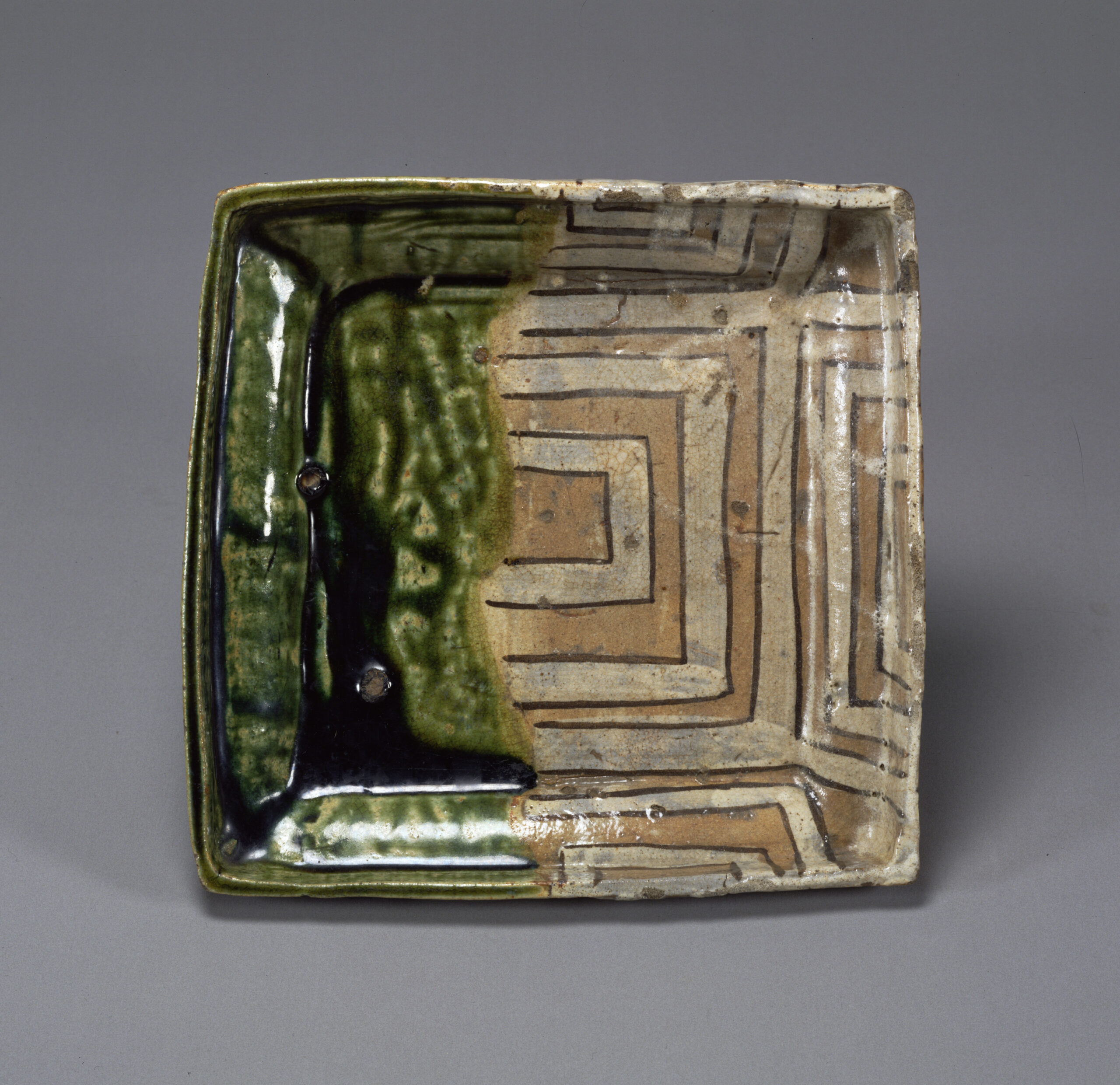
Holding institution: Tokyo National Museum.
Institutional ID: G-4827.
Source: ColBase (National Institutes for Cultural Heritage).
Source page: https://colbase.nich.go.jp/collection_items/tnm/G-4827
The square bowl demonstrates structural segmentation. Its interior is divided into geometric compartments. Green glaze occupies one quadrant heavily, while the remaining surfaces remain exposed or minimally treated. This distribution interrupts visual continuity.
The segmentation does not create chaos. Instead, it redistributes attention. The eye moves between planes rather than resting at a centered focal point. Surface hierarchy becomes multi-nodal.
4. Glaze Displacement — Green-Glazed Flat Bowl

Holding institution: Kyoto National Museum.
Institutional ID: G甲300.
Source: ColBase (National Institutes for Cultural Heritage).
Source page: https://colbase.nich.go.jp/collection_items/knm/G%E7%94%B2300
This flat bowl presents asymmetrical glaze displacement. The copper green glaze concentrates on one side, while the opposite surface remains comparatively open. The decorative motif does not align with geometric center.
Such displacement produces lateral tension. The composition is stable yet visibly unbalanced. The system allows imbalance as long as proportional relations remain controlled.
5. Redistribution of Compression — Black Oribe Tea Bowl
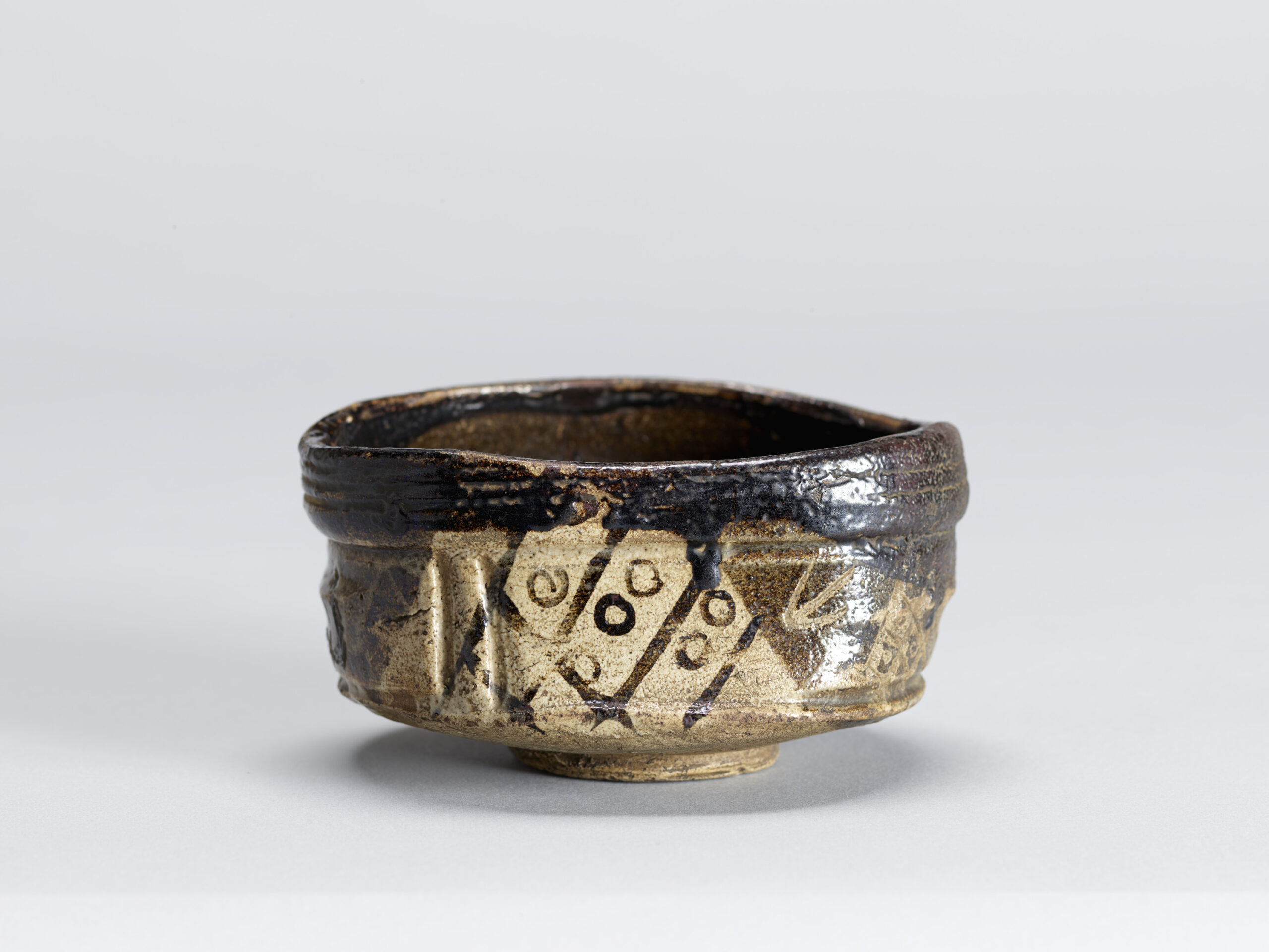
Holding institution: Kyoto National Museum.
Institutional ID: G甲638.
Source: ColBase (National Institutes for Cultural Heritage).
Source page: https://colbase.nich.go.jp/collection_items/knm/G%E7%94%B2638
The black Oribe tea bowl demonstrates redistribution within a compressed form. The cylindrical body retains structural compactness. However, a horizontal band of decoration interrupts the visual field.
Compression remains intact, yet visual rhythm increases. The object reorganizes restraint into layered hierarchy.
6. Political Context and Stabilization
Oribe’s structural expansion occurred during the transition from Momoyama turbulence to early Tokugawa order. Tea was no longer confined to monastic or merchant circles. It became embedded within samurai administration.
This shift required aesthetic adaptability. Extreme minimalism alone could not sustain broader institutional use. Controlled distortion allowed variation without dissolving inherited discipline. The system expanded while preserving internal grammar.
In this sense, Oribe functioned as a mediator. He neither abandoned compression nor intensified it. He redistributed it so that chanoyu could operate within emerging political stability.
Conclusion
Furuta Oribe did not dismantle the aesthetic achieved under Sen no Rikyū. He redistributed its internal weight. Distortion in his work operates as structural release within inherited constraints. This controlled expansion enabled the transition from extreme compression toward adaptive stabilization.
References
- Kumakura, I. (2001). Furuta Oribe to Momoyama no Cha. Tankōsha.
- Yabe, Y. (1999). Furuta Oribe: Momoyama Bunka o Enshutsu Suru. Kadokawa.
- Fujio, M. (1978). Momoyama no Cha to Furuta Oribe. Chūō Kōron.
- Hayashiya, T. (1970). Chanoyu. Kodansha International.
- ColBase (National Institutes for Cultural Heritage). Object records: G-4827, G甲300, G甲638.